
How to Send Money from GCash to PayPal: 2026 Guide for Filipinos
Learn how to send money from GCash to PayPal in the Philippines, including linking steps, fees, transfer times, and cheaper alternatives.





The Pag-IBIG Fund¹ offers both mandatory and voluntary opportunities for Filipinos to save as well as access to loans and financial support. If you’re working for an employer in the Philippines, both you and your company will pay your Pag-IBIG contributions - but as an OFW, you'll need to manage this yourself. Contributions for 2026 are usually 200 PHP² - or more if you want to maximise the savings opportunities.
Read on to learn about the OFW Pag-IBIG contribution you need to make - and also how to pay Pag-IBIG from abroad conveniently. We'll also introduce the Wise account, a handy companion to make your money go further with low, transparent fees.
| Table of Contents |
|---|
The Pag-IBIG Fund, also known as the Home Development Mutual Fund, comprises both mandatory and voluntary savings programs for Filipinos. Members earn annual dividends, and can also access affordable financing for home buying, emergencies and other purposes.
Pag-IBIG savings in the mandatory fund can usually only be drawn under fixed circumstances - normally after contributing for 20 years. There are rules to release funds early if needed, such as in the event of the member becoming ill or disabled.
In this guide, we’ll cover how much the Pag-IBIG contribution is for OFWs, and how to make a Pag-IBIG virtual payment using your debit card or ewallet, no matter where in the world you are.
Pag-IBIG members can benefit from the following:
Pag-IBIG membership is mandatory under Philippine law, and therefore OFWs must be members of the fund³.
However, as contributions are not automatically deducted, OFWs must pay manually or online to maintain their membership and have access to the benefits of the scheme. If you stop contributing, membership becomes inactive, and you can lose access to loans and benefits, as well as lose the opportunity to save and earn a dividend.
As well as the mandatory membership of the Pag-IBIG regular savings program, there’s also the MP2 voluntary savings plan⁴, which lets you save extra, with a higher rate of return. This can be an attractive option for OFWs who want to make the most of the opportunity to save and grow their income.
The Pag-IBIG contribution is set at 2% of your monthly income, to the limit of the Maximum Fund Salary (MFS), which is set at 10,000 PHP. This means that the maximum mandatory contribution is 2% of 10,000 PHP - 200 PHP.
If you earn less than this amount, you pay proportionally to your salary - and you can always contribute more if you choose to.
OFW Pag-IBIG contribution rates are usually around 200 PHP monthly for the mandatory scheme. There’s no contribution required from the overseas employer, and the individual OFW must make contributions independently.
For the voluntary MP2 savings scheme, you can pay in amounts from 500 PHP per remittance, with an upper limit of 20 million PHP principal in the account at any given time. If you have 100,000 PHP or more in your MP2 account, you may need to provide proof of source of funds for a legal and compliance check by the Pag-IBIG team.
Pag-IBIG payments can be made online or through partners such as banks with an overseas branch network. For OFWs, the easiest way to pay may be using the Pag-IBIG Virtual online system, as this lets you manage your contribution remotely and pay with a card or ewallet.
Here’s a summary of the most popular options to make Pag-IBIG payments as an OFW, so you can decide which might suit your own specific needs.
There are 23 Pag-IBIG branches overseas, which are often found inside embassy buildings. If you’re close to a physical branch, you may choose to pay your Pag-IBIG contributions here for a face-to-face service.
You can make your payment through a bank such as PNB or Asia United Bank. You can also use Ventaja PayRemit⁵, which is a government-partnered remittance service for digital payments.
If you want to make a contribution in person, you can do so in a PNB branch, which you'll find in Hong Kong, Singapore and Dubai. Once there, you take the following steps:
To make your payment digitally, download PayRemit and select the option to “Pay Contribution.” Here you can select the contribution type to make, and then follow the instructions to make your payment.
The Pag-IBIG Virtual service lets you pay your contributions either entirely online or by dropping into a 7-Eleven branch if you’re in the Philippines. If you’re using the fully digital service, you’ll be able to pay with GCash or Maya. Here’s what to do to pay with GCash as an example:
If you’re in the Philippines - on a home visit, for example - you can make your payment over the counter at locations like Metrobank and LandBank, as well as M. Lhuillier. Take along your Membership ID Number (MID) to your preferred location - fees can apply depending on the service you select.
Many OFWs face challenges when paying their Pag-IBIG contributions from abroad, including high remittance fees, poor exchange rates that reduce the value of their money, delays in processing, and overall inconvenience when using traditional payment methods.
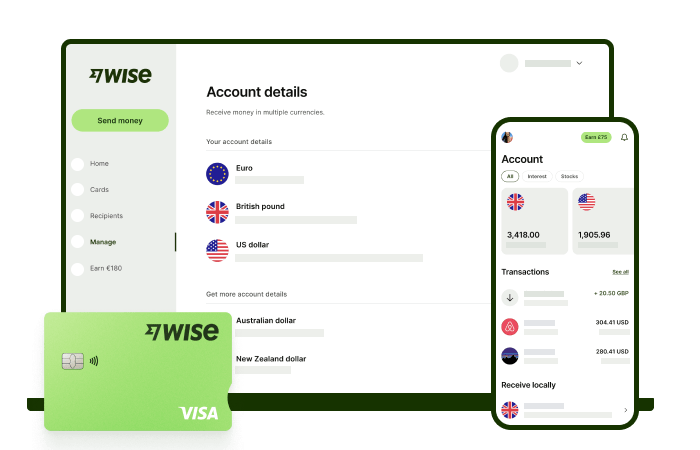
The Wise account is an easy way to hold and exchange 40+ currencies, including PHP, USD, CNY, and more. All you need to do is create a free account to get started.
With Wise, you can exchange currencies at the mid-market rate each time, with low, transparent conversion fees from 0.57% and absolutely no markups. Plus, you can order a Wise card for convenient spending at the same great rate, without any foreign transaction fees.
In supported countries, you can also use Wise to pay with QR codes, which means you can pay like a local without needing cash or a separate local wallet. This can be especially handy when you're travelling in places where QR payments are widely accepted.
At times you need cash, you can also make up to 2 free ATM withdrawals to the value of 12,000 PHP when you're overseas. You'll even get 8+ local account details to get paid conveniently to your Wise account in PHP and a selection of other major global currencies.
Sending money or making payments abroad? Wise also offers fast, low cost transfers to 140+ countries - you can track your transfer in your account and your recipient will also be notified when a transfer reaches them.
✍️ Sign up for a free account now
*Please see terms of use and product availability for your region or visit Wise fees and pricing for the most up to date pricing and fee information.
This publication is provided for general information purposes and does not constitute legal, tax or other professional advice from Wise Payments Limited or its subsidiaries and its affiliates, and it is not intended as a substitute for obtaining advice from a financial advisor or any other professional.
We make no representations, warranties or guarantees, whether expressed or implied, that the content in the publication is accurate, complete or up to date.
Learn how to send money from GCash to PayPal in the Philippines, including linking steps, fees, transfer times, and cheaper alternatives.

Learn how to apply for a BPI credit card online, through the BPI app or at a branch. Compare requirements, documents and fees before you apply.
Learn how to use your RCBC credit card abroad, including foreign transaction fees, exchange rates, overseas cash withdrawals and travel perks.

Learn the PhilHealth contribution for OFWs, including current rates, payment options, how to pay from abroad and how to check your status.

Applying for a BPI credit card as an OFW? Learn the requirements, documents, income rules, and how to apply online from abroad step by step.

Looking for your first credit card? Compare UnionBank credit cards for beginners, including fees, requirements, and how to apply.











