
Can Australians Buy Property in Canada: All You Need to Know
Can Australians buy property in Canada? Learn everything you need to know before your property purchase.





*Pricing claim based on comparative data for select airports and passes. Live pricing is subject to exchange rate fluctuations.
📱Find out how to get lounge access
If you’re an Aussie living in the UK, or if you’re considering investing in UK property from Australia to rent out, you’ll need to understand how the property purchase process works in England, Scotland, Northern Ireland or Wales.
So - can Australians buy property in the UK, and what restrictions are there? This guide covers buying UK property from Australia, looking at costs, legal process and market conditions. We'll also share how Wise can help you move your funds to the UK with the mid-market rate if you need to finance your purchase from abroad. Plus, you’ll get dedicated support and volume discounts when sending large amounts.

Yes. Australians can buy property in the UK without restrictions - however, there are additional taxes if you’re buying as a non-UK resident or if you’re buying a second (or subsequent) home.
The process of buying a house - and the taxes applied - vary between England, Scotland, Northern Ireland and Wales, so it’s helpful to get localised advice based on the property location.
No. There is no UK residency visa, so if you buy a UK property you’ll still need to abide by normal visa conditions. Generally Aussies can enter the UK for up to 6 months as a tourist using an ETA, or get a dedicated visa for longer stays, to work or to study¹.
The UK’s property market has been steady, with relatively low growth, but generally remaining in positive territory of late. However, the growth of house prices in the UK has slowed to about 0.4% from 0.8% in the first quarter of 2026, as tensions in the Middle East damage consumer confidence leading to concerns about inflation².
The situation may change rapidly - watching the market carefully is key to deciding if this is the right time for you to buy property in the UK.
| Pros | Cons |
|
|
The average house price in the UK (February 2026) is 267,957 GBP³. This masks large regional variances, which often mean properties in the south of England and London are far more costly than places further north or in smaller towns and rural areas.
UK local government house price data reflects this - here are the regional median house prices by region of England for the full year to Q3 2025⁴:
| Region | Main cities/towns | Median house price |
|---|---|---|
| East of England | Cambridge, Norwich | 348,000 GBP |
| East Midlands | Nottingham, Leicester | 250,000 GBP |
| London | London | 527,000 GBP |
| North East | Newcastle upon Tyne, Sunderland | 172,000 GBP |
| North West | Manchester, Liverpool | 221,000 GBP |
| South East | Oxford, Southampton | 383,000 GBP |
| South West | Bristol, Plymouth | 310,000 GBP |
| West Midlands | Birmingham, Coventry | 252,000 GBP |
| Yorkshire and Humberside | Leeds, Sheffield | 215,000 GBP |
*Correct at time of research - 13th May 2026
House prices in Scotland, Wales and Northern Ireland vary. The median price in Scotland is 187,000 GBP⁵, while in Wales it is 207,000 GBP⁶. In Northern Ireland the average house costs just under 196,000 GBP⁷.
Looking for a property in the UK is likely to begin online. Umbrella websites aggregate listings from many different real estate agents which make them a good place to start your hunt, with filter and search tools to drill down to the type of property and location that might suit you.
Check out these real estate websites to start your search for an ideal UK property:
Once you’ve identified properties that meet your requirements you can then reach out to individual estate agents to support your search in person, arranging visits and talking through different properties in more detail.
Here’s a quick overview of how to buy a property in England, Wales or Northern Ireland - as the property differs for Scottish properties, it’s worth getting specialist advice if you’re considering a new place north of the border.
Step 1: Set your UK property purchase budget
As well as the price of the home, you’ll also need to budget for taxes, fees and legal costs⁸. Creating a budget early can help you narrow down your search and find the right place more easily.
Step 2: Research properties online
Using umbrella websites to start your property search is efficient and allows you to get a feel for costs and availability in your target area.
Step 3: Use an agent to conduct viewings and offer
Once you’ve found some properties you like, contact agents to arrange viewings. When you’ve found the right place for you, make an offer - this is done through the agent usually, although sealed bids and auctions are more common for Scottish properties.
Step 4: Find a solicitor and complete due diligence
When you have agreed a sale price you need to engage a solicitor or conveyancer in the UK. They complete due diligence checks such as searches and surveys. You may also want to get a building inspection completed depending on the property and your mortgage provider’s requirements.
Step 5: Exchange and pay your deposit
The sale becomes legally binding once you exchange contracts. At this point you pay a deposit - usually 10% of the purchase price - which you would forfeit if you drop out of the deal later. You agree on a date for completion with the seller - usually a few weeks after exchanging.
Step 6: Get your keys on completion day
All final checks are completed and you will then complete the purchase by paying your remaining money to the seller, and arranging your tax payments through your solicitor. The property is registered in your name and you’ll be ready to move in.
The UK government suggests you may pay around 5,000 GBP in fees and costs⁹ when buying a property, on top of the cost of the home and your Stamp Duty Land Tax (SDLT).
Stamp Duty Land Tax (SDLT) (or the equivalent in Scotland and Wales) is usually the highest fee you’ll pay - we’ll cover this in more detail in the next section. On top of this, budget for costs including the following:
| Fee type | Average costs |
|---|---|
| Estate agent fees | Often paid by seller |
| Mortgage fees (if applicable) | 1,200 GBP or more |
| Survey fees | 400 GBP to 1,500 GBP |
| Home insurance | 300 GBP - 400 GBP on average |
| Legal and conveyancing | 2,000 GBP or more |
*Correct at time of research - 13th May 2026
Stamp Duty Land Tax (SDLT)¹⁰ applies on purchases made in England or Northern Ireland. If you’re buying a home in Scotland¹¹ or Wales¹² fees apply, but they have slightly different names and bandings. As this is likely to be the highest of all the fees involved when you buy a property in the UK as an Aussie, it’s crucial you understand it in advance.
You’ll need to get the full details of how stamp duty taxes apply based on the location and value of your property, where you’re a tax resident and whether or not it’s a second home. To illustrate, here’s how it works in England and Northern Ireland:
| Value of property | SDLT basic rate (England and Northern Ireland)⁷ |
|---|---|
| Up to £125,000 | 0% |
| The next £125,000 (the portion from £125,001 to £250,000) | 2% |
| The next £675,000 (the portion from £250,001 to £925,000) | 5% |
| The next £575,000 (the portion from £925,001 to £1.5 million) | 10% |
| The remaining amount (the portion above £1.5 million) | 12% |
*Details correct at time of research - 13th May 2026
If you’re buying a property in England or Northern Ireland and you are not a UK resident - or if this is a second home property, you’ll pay the amount outlined in the table above, plus the following¹³:
UK banks set their own rules on eligibility for mortgages, but there are likely to be options for Australian citizens, including non-UK residents to get a mortgage for a UK property.
If you’re already a UK resident you will find there’s a broad range of mortgage options including variable and fixed rate products. Non-residents can also look to global providers such as HSBC¹⁴ which offers Aussie residents mortgages in the UK subject to meeting earning requirements and having a 24% - 40% deposit available depending on the property value.
- Engage a conveyancer or solicitor experienced in working with Aussie buyers to ensure the process runs smoothly
- Have your own paperwork prepared in advance, including proof of the source of the funds which is needed for anti-money laundering checks
- Make sure you understand UK stamp duty, which depends on the location and value of your property, where you’re a tax resident and whether or not it’s a second home
- Consider using Wise to send your AUD to the UK and when paying your deposit, fees and mortgage in pounds - you’ll get the mid-market rate with low, transparent costs
Use the calculator below to estimate how much your money could be worth in GBP before making an international property payment.
If you’re buying property in the UK, you may need to send money internationally from Australia for your deposit, stamp duties, legal fees or final property payment. Wise is an easy way to save up to 5x when sending money overseas. You can make extra secure transfers to 140+ countries, which are easy to set up with no physical paperwork and completed usually in seconds.
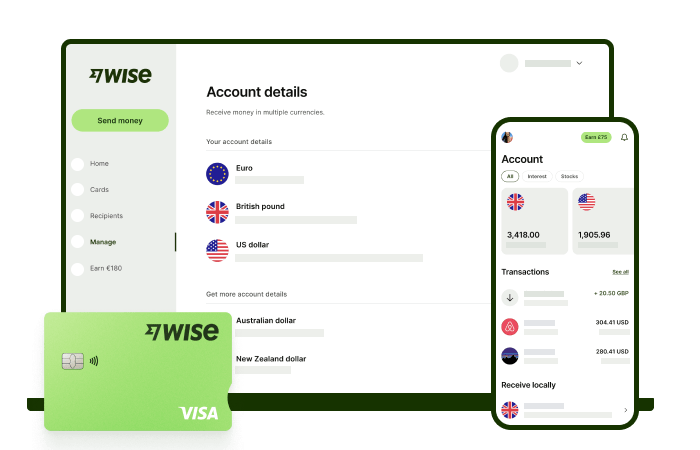
With low, transparent pricing and the mid-market exchange rate for all your currency conversions for your foreign transfers, you'll usually get the best value for your money. Wise lets you see exactly what you're paying for a transfer, and what the recipient will get, with no hidden fees.
For managing foreign currencies even easier, create a free Wise account, and you'll be able to manage and convert your money in AUD and 40+ other currencies. Plus, you'll get local account details in 8+ currencies, including GBP, USD, and more making it easy to receive money from abroad whenever you need. You'll be able to track your transfers all in one place.
When it comes to international transfers, Wise makes things easier and cheaper.
This general advice does not take into account your objectives, financial circumstances or needs and you should consider if it is appropriate for you. Savings claim based on our rates vs. selected Australian banks and other similar providers in Jan 2026. To learn more please visit https://payout-surge.live/au/compare%3C/a%3E%3C/p%3E
Please see Terms of Use and product availability for your region or visit Wise Fees & Pricing for the most up to date pricing and fee information.
Sources:
*Please see terms of use and product availability for your region or visit Wise fees and pricing for the most up to date pricing and fee information.
This publication is provided for general information purposes and does not constitute legal, tax or other professional advice from Wise Payments Limited or its subsidiaries and its affiliates, and it is not intended as a substitute for obtaining advice from a financial advisor or any other professional.
We make no representations, warranties or guarantees, whether expressed or implied, that the content in the publication is accurate, complete or up to date.

Can Australians buy property in Canada? Learn everything you need to know before your property purchase.

Can Australians buy property in Indonesia? Learn everything you need to know before your property purchase.

Can Australians buy property in Vietnam? Learn everything you need to know before your property purchase.
Can permanent residents buy property in Australia? Learn everything you need to know before your property purchase.

*Pricing claim based on comparative data for select airports and passes. Live pricing is subject to exchange rate fluctuations. 📱Get your lounge...

*Pricing claim based on comparative data for select airports and passes. Live pricing is subject to exchange rate fluctuations. 📱Get your lounge...











