Invoice automation: Process, pitfalls and considerations
Discover how to build an end-to-end invoice automation workflow, avoid the pay-out gap, and scale your business with integrated payment solutions.



Aussies love online shopping. In 2025, 9.8 million households spent a collective $82.6 billion online, a 14% increase from 2024.1 To get a slice of that lucrative digital pie, your business needs an efficient, cost-effective way to start accepting online payments.
From considerations to challenges and methods, this post covers how to accept online payments in Australia.
| Table of Contents |
|---|


You’ve seen the stats. E-commerce has become a pillar of the Australian retail landscape. Thanks to consistent year-on-year growth, the trend looks set to stay.
From retail to hospitality and professional services, Aussie SMBs are adapting to the digital era in droves. Even traditionally offline businesses – tradespeople, hairdressers, tutors – have begun accepting online payments for good reason:
Most Australian sectors can benefit from online payments, even those that primarily trade offline. This is especially true in sectors such as:
Online payments are crucial to business success. But the tech does come with challenges, especially for smaller Australian businesses with limited expertise. Here are some of the most common issues businesses need to be prepared for:
Ready to get cracking? Here’s how to accept payments online in Australia.
If you don’t already have one, research the best business accounts in Australia and select one that aligns with your needs. Companies and partnerships must have a business account to trade in Australia, and it’s a good idea for sole traders as well.2 Aussies trading overseas might want to prioritise a good business account for international payments.

The ideal online payment system depends on your business. Will customers primarily pay invoices or through a payment gateway? Does your business generally charge one-off or recurring payments through a subscription model? Consider which payment methods best suit your business and whether foreign exchange is required.

Review the top payment gateways and processors available in Australia, weighing up the features that offer the greatest benefit to your business. Carefully compare the associated fees, including upfront costs, subscriptions, and per-transaction rates. Some payment service providers in Australia cost more than others, which affects your bottom line.
The precise sign-up process varies between platforms. The best global payment gateways have simple, intuitive interfaces that cater to everyday users. Nonetheless, expect to fill out various forms and comply with verification requirements. To receive funds in the correct place, you’ll need to link your business account.
Again, this step varies widely between businesses and platforms. Sole-trading service providers, such as plumbers or consultants, could set up an invoice generator or a payment link that accepts bank transfers and credit cards. E-commerce stores might need to hire a web developer to integrate customised APIs with a payment gateway. Alternatively, some entrepreneurs prefer to work with existing Shopify integrations instead.
Businesses trading locally must comply with the Australian Consumer Law (ACL), a nationwide framework that outlines business responsibilities. For example, businesses must include the minimum surcharge in the final price if there is no way to pay without a surcharge.3 Businesses may also need to consider the Privacy Act when collecting customer data, as well as the Australian Guidelines for Electronic Commerce.
Configure features such as currency conversions, recurring payments, and Buy Now, Pay Later (BNPL) schemes. With the payment system in test mode, you could try simulating transactions of varying sizes and types to ensure everything runs smoothly.
Upon launching an online payment system, most businesses monitor transactions to identify potential real-world issues. Periodically reviewing your user dashboard can help with tracking revenue or responding to disputes.
There are many ways Australian businesses can receive money online.
Businesses can accept card payments and digital wallets through several methods, including payment gateways, invoices, payment links, and QR codes. Australian credit card fees typically range from 0.5% to 1.5%, while EFTPOS fees are usually below 0.5%. Most international transactions attract a 3% fee, often with an extra commission baked into the foreign exchange rate.
In Australia, a business cannot legally charge more for a card surcharge than it costs them.4
The classic bank transfer, officially known as an EFT (Electronic Funds Transfer), is a common business-to-business (B2B) online payment option, especially for contractors and suppliers. Some business-to-consumer (B2C) retailers accept them as a cheap alternative to credit cards when selling big-ticket items like holidays or cars.
In Australia, bank transfers run through the New Payments Platform (NPP), which uses Osko by BPAY to allow near-instant transfers between most local banks. The platform also facilitates PayID, where users enter an easy-to-remember identifier, such as a mobile or email address, instead of a BSB and account number.
Businesses receiving recurring payments may prefer direct debit. After acquiring a signed Direct Debit Request (DDR) form, the business pulls funds directly from the customer’s account at an agreed-upon schedule – weekly, monthly, annually, etc.
Direct debits occur automatically until cancelled, making them more convenient for businesses and customers. The payment method is popular for recurring services such as utilities, streaming networks, software subscriptions, insurance, and gym memberships.
Businesses big and small use digital invoices to bill clients online, often offering payment methods such as cards, digital wallets, and bank transfers. Accounting software can streamline invoicing by automating reminders, reconciling payments, and calculating GST.
For B2B payments, larger businesses often use e-invoicing, a time-saving system that reduces administrative costs. Upon creation, the electronic invoice is automatically delivered to the recipient through a secure direct connection, ready for processing and payment.


Many businesses accept card-not-present (CNP) card and digital wallet payments through a payment gateway, a secure online portal that serves as an intermediary between the customer and merchant.
Aussie SMBs typically use hosted third-party gateways, which handle complex security and compliance requirements. From the user's perspective, a new window pops up during the transaction, which sometimes involves multi-factor authentication.
Also known as a pay-by-link, the merchant sends a unique URL to the customer via SMS or email that directs to a secure payment page. This convenient method doesn’t require a website, merchant account, or Point of Sale (POS) terminal, making it an accessible choice for small Aussie businesses and sole traders.
The provider normally handles security and compliance. Payment links may support cards, digital wallets, and, in some cases, bank transfers.

The merchant prints and displays a QR code, often on restaurant tables or menus. Upon scanning it, the customer gets sent to a payment gateway to select their choices and finalise the transaction. Some businesses send QR codes electronically, usually through an invoice or email.
Static QR codes don’t change, meaning the customer must input a payment amount. Dynamic QR codes generate a unique code for each transaction, reflecting a specific amount.
There are several factors a business can consider when accepting online payments in Australia, such as:
Australian businesses trading overseas lose money each month from international transaction fees and unfavourable exchange rates.
Expanding a business globally opens up exciting opportunities, but also new challenges like receiving payments across borders. Hidden foreign transaction fees and hefty currency conversions involved with international payments can eat into your profits and time.
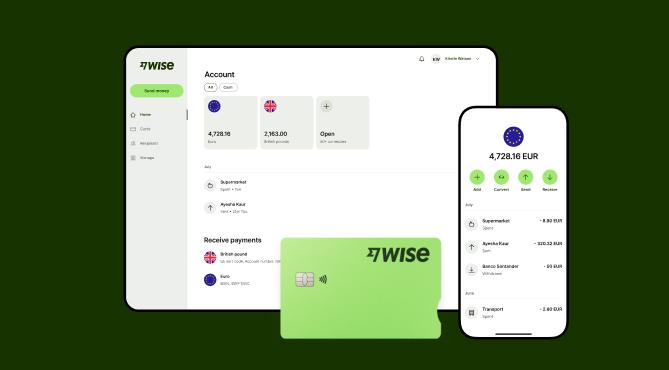
Wise Business serves as a cost-effective solution where you can receive money from around the world at the speed and price of local payments.
Transform the way you receive payments with Wise Business:
Sign up for the Wise Business account! 🚀
This general advice does not take into account your objectives, financial circumstances or needs and you should consider if it is appropriate for you.
1. How can I accept payments online without a merchant account?
Small Australian businesses without a merchant account can receive payments online by creating a Wise Business account, which facilitates card payments through invoices, payment links, and QR codes.
2. What are the typical fees involved for small businesses accepting payments online in Australia?
Domestic card payments usually cost between 1.5 and 2.5%, plus a fixed transaction fee of around $0.30. International payments generally cost an extra 1% upfront, and many payment processors add a commission to the exchange rate.
3. How to receive payments online for free?
Small businesses can use invoices, QR codes, or payment links to accept free online payments via domestic bank transfers. Payments made by credit card or digital wallet will always attract fees.
Sources:
*Please see terms of use and product availability for your region or visit Wise fees and pricing for the most up to date pricing and fee information.
This publication is provided for general information purposes and does not constitute legal, tax or other professional advice from Wise Payments Limited or its subsidiaries and its affiliates, and it is not intended as a substitute for obtaining advice from a financial advisor or any other professional.
We make no representations, warranties or guarantees, whether expressed or implied, that the content in the publication is accurate, complete or up to date.

Discover how to build an end-to-end invoice automation workflow, avoid the pay-out gap, and scale your business with integrated payment solutions.

Need a payment processing solution for your business? We’re covering everything you need to know to start payment processing in Australia.
Compare the best Shopify payment methods for Australian businesses, and find the right solution to lower your transaction fees and boost sales.

Tired of late payments? Our guide covers what to include in an invoice, best practices, and methods for sending them to ensure you get paid on time, every time.