
How to enable international transactions on your ICICI debit card
Planning a trip abroad? Learn how to quickly enable international transactions on your ICICI debit card.



The Wise Travel card lets you hold 40+ currencies and spend at the interbank exchange rate with no forex markups or hidden fees - now available to order for free (Limited time offer, while stocks last).
Order your free Wise Travel card 💳
Planning an international trip? Compare forex cards with credit cards to determine which one offers the best value, safety, and convenience for your global travel needs.
When travelling abroad, choosing the proper payment method is crucial because it can significantly impact the smoothness of your trip and the amount of money you spend. You have multiple options in forex travel cards, international credit cards, cash, and traveller’s cheques. This guide breaks down each option, helping you decide which is better for your next trip, whether you're traveling for business, vacation, or studying abroad. We'll also introduce you to the Wise Travel card, which allows you to hold 40+ currencies in on card and spend without any forex markups or hidden fees.
| Table of contents |
|---|

You will need to spend money when you travel abroad. Fortunately, travellers have multiple options for spending overseas. Let's explore the four primary methods to determine which is most ideal.
A forex card is typically a prepaid multi-currency card designed specifically for international travel. You load money onto the card in Indian Rupees (INR) before your trip, and you can then convert and hold that balance in one or multiple foreign currencies (like USD, EUR, or AUD) on the card's balance.
In India, these are widely offered by major institutions like HDFC Bank (e.g., Regalia ForexPlus Card)¹ and ICICI Bank (e.g., Multicurrency Forex Prepaid Card)², as well as digital providers like the Wise Travel card³.
Here are the pros and cons of forex cards.
| Pros4 | Cons5 | |
|---|---|---|
| Forex card |
|
|
A credit card allows you to make purchases using borrowed funds (your credit limit). When you use your standard Indian credit card overseas, the foreign currency transaction is converted back to INR by the bank, usually incurring several fees.
For many Indian cards, this means paying a foreign transaction fee (forex markup), which can range from 2% to 4% of the total purchase amount. While a credit card is excellent for large, emergency purchases, relying on it for everyday spending is the fastest way to accrue significant fees.
Almost every bank in India offers credit cards to its customers. For example, HDFC Bank, ICICI Bank, and State Bank of India have multiple credit card products.6 Foreign card issuers, such as American Express (Amex)8 and Diners Club International, also issue credit cards to Indian customers.
Here are the pros and cons of credit cards.
| Pros9 | Cons10 | |
|---|---|---|
| Credit Cards |
|
|
To travel with cash, you must typically purchase it from a local money changer (such as Thomas Cook11) or a bank branch in India or withdraw it from an ATM overseas.
Carrying local cash is essential for smaller vendors, local markets, and tipping, but it poses the highest security risk when carried in large volumes.
Here are the pros and cons of using cash abroad.12
| Pros | Cons | |
|---|---|---|
| Cash |
|
|
A traveller’s cheque is a pre-printed, fixed-value paper document that can be exchanged for local currency in a foreign country.13 These were historically the safest way to carry money overseas before the advent of modern cards, as they required the owner's signature for validation.
Traveller’s cheques are now largely obsolete. Most modern banks, exchange houses, and merchants no longer accept them. These instruments have been discontinued in favour of the foreign exchange travel card. Previously, banks and companies such as American Express, Travelex, Visa, and Thomas Cook issued these instruments.
Let’s compare a forex card, a credit card, and cash to know which one is better suited for international travel.
Below, you will find a side-by-side comparison of these payment methods.
| Forex markup | ATM withdrawal | Loading | |
|---|---|---|---|
| Forex card | Usually zero | Usually free up to a monthly limit, low variable fee after | Can reload/top up online from anywhere |
| Credit card | Typically 2-3.5% on every international transaction | High cash advance fees | Not required, spend based on credit limit |
| Cash | Depends on variable rate set by the money changer/bank | Must be purchased/exchanged | Purchased from a bank/money changer |
When considering the best method for spending overseas, the most practical approach for the modern traveler is a combination of cash and cards. If you are a fan of additional travel benefits and don't mind paying for them, a credit card can offer desirable travel perks; however, its high forex markup fees mean it is best saved for emergencies if you're hoping to keep costs down. It’s always good to carry some cash on hand for local markets and small transactions. Ultimately, the forex card, such as the Wise Travel card, is the ideal primary option for everyday spending, offering better cost savings and rate protection compared to a traditional credit card, and even allowing you to withdraw local cash when needed.
With no hidden markups, the Wise Travel card is a smart way to spend abroad. You'll always get the real interbank exchange rate for conversions across 40+ currencies. Wise's transparent, low pricing, plus no foreign transaction fees or forex markups, usually means you are getting the best value for your money.

The fully digital account opening and vKYC process allows you to sign up from the comfort of your home, and there are no annual or monthly fees either. Simply order your card, show proof of your travels, load your funds, and you're all set. Plus - card orders are currently free to Indian addresses (limited time launch offer, while stocks last)! A physical Wise card enables you to make secure chip and PIN payments and get some free ATM withdrawals while you're overseas. You can also instantly freeze or unfreeze your card in the app anytime for peace of mind.
Wherever your travels take you, the Wise Travel card is the only forex card you'll need to make spending internationally simpler and cheaper.
*Please see terms of use and product availability for your region or visit Wise fees and pricing for the most up to date pricing and fee information.
This publication is provided for general information purposes and does not constitute legal, tax or other professional advice from Wise Payments Limited or its subsidiaries and its affiliates, and it is not intended as a substitute for obtaining advice from a financial advisor or any other professional.
We make no representations, warranties or guarantees, whether expressed or implied, that the content in the publication is accurate, complete or up to date.

Planning a trip abroad? Learn how to quickly enable international transactions on your ICICI debit card.

Compare India's best zero forex markup credit cards and discover a more transparent debit alternative for your next trip.
Planning a trip abroad? Learn everything about forex cards for international travel. We cover what they are, how they work, how to get one.
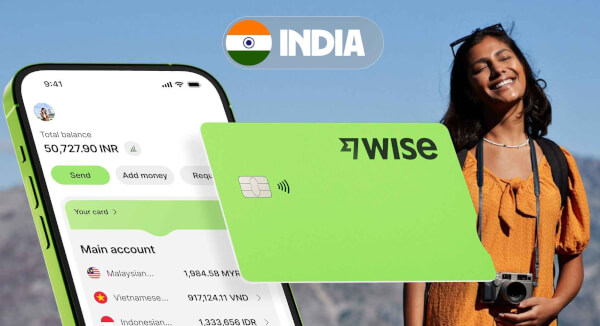
Everything Indian residents need to know about the Wise Travel Card: See the features, transparent fees, and simple process for how you can get one.











