
How to enable international transactions on your ICICI debit card
Planning a trip abroad? Learn how to quickly enable international transactions on your ICICI debit card.



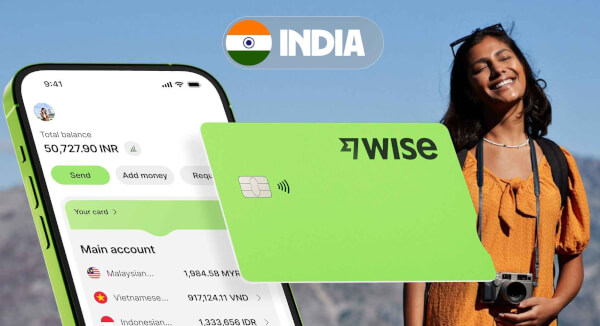
The Wise Travel card lets you hold 40+ currencies and spend at the interbank exchange rate with no forex markups or hidden fees - now available to order for free (Limited time offer, while stocks last).
Order your free Wise Travel card 💳
International travel often comes with the challenge of managing money efficiently. Between fluctuating exchange rates, hefty bank fees, and the risk of carrying large amounts of cash, it’s easy for a significant chunk of your travel budget to be lost before you even buy a souvenir. This is where the forex card has emerged as a popular and smart solution for Indian travellers.
This guide will walk you through what a forex card is and how it works, helping you understand its meaning, benefits, and how it compares to other payment options. We’ll cover practical advice on how to get a forex card. We'll also introduce you to the Wise Travel card, which allows you to hold 40+ currencies in on card and spend without any forex markups or hidden fees.
| Table of contents |
|---|

A forex card (also known as forex prepaid card or a travel card) is a card designed specifically for international transactions. However, not all forex cards work the same way. Depending on how you prefer to manage your money, you will likely choose between two main variants:
INR-based travel card
An INR-based travel card functions by holding your balance in Indian Rupees and performing a real-time conversion at the prevailing rate whenever you swipe abroad. These cards usually feature zero forex markup, which means you're not charged for the 1-3% added foreign transaction fee that you're typically charged.
Multi-currency forex card
A multi-currency card allows you to "lock in" exchange rates by pre-loading specific foreign currencies (like USD, EUR, or GBP) before you travel. Since the conversion from INR happens at the time of loading, your balance remains shielded from market fluctuations during your trip.
Issued by banks and financial providers, both variants are designed to be more cost-effective than using a standard debit or credit card for overseas spending.1 They are widely accepted for dining, shopping, online transactions, and ATM withdrawals abroad.
Popular forex card options in India include traditional bank offerings like the ICICI Bank Forex Cards, as well as specialised providers like the BookMyForex Card and the Wise Travel card.
Check out our guide to compare the best forex cards in India.
Is a forex card similar to your international credit card? Although both let you spend abroad, they differ significantly in cost and structure.2
Essentially, credit cards are best kept for emergencies, while the forex card is the more cost-effective tool for daily travel needs.
As a traveller, your next question is likely “Is a forex card better than cash?” For most of your travel budget, the answer is a yes. While cash is useful for small tips or street vendors, a forex card is usually safer and more economical. Let’s explore the pros and cons of a forex card vs. cash.3
Overall, if you’re heading to a country where digital payments are generally accepted, it’s more convenient to use a forex card and carry only a small amount of cash for tips, small vendors, and emergencies.
The way a forex card functions depends on whether you choose a multi-currency or an INR-based variant. While both offer a seamless experience abroad, their underlying mechanisms differ:4
For your multi-currency forex card, you load the card in India by converting INR into the foreign currency of your choice (e.g., USD, EUR) before you travel. You can often load multiple currencies on a single card.
With the INR-based card, You simply load the card with Indian Rupees (INR) from your bank account. There is no need to decide which foreign currency you need in advance.
Once you are abroad, both cards function just like your everyday debit card. All shops, restaurants, and online platforms that accept major networks like Visa or Mastercard will honour them.
When it comes to the multi-currency card, the card detects the local currency and deducts funds directly from the corresponding currency wallet, while the INR-based card a real-time conversion at the point of sale, deducting the equivalent INR amount from your balance using the prevailing rate.
You can also withdraw local cash at any compliant ATM as you would with your standard cards.
With all the forex card options out there, it can get overwhelming to decide what’s right for you. Here are the key things to look out for when choosing a forex card.7
Forex cards come with various fees. Look for charges associated with issuance, reloading, ATM withdrawals, and inactivity. Some cards might waive issuance fees but compensate by charging high withdrawal or transaction fees. Look at the entire fee structure.
Exchange rate markups are often the hidden fees of international spending. Even when a provider claims "zero fees" or "no forex", they may still apply a spread to the conversion rate. To spot these discrepancies, compare the provider's rate you receive with the interbank rate (the rate you see on Google), which you can see below.
Transparent providers, such as Wise, always uses the interbank rate for every conversion, ensuring you aren't paying a hidden charge.
You should opt for cards that offer online or app-based reloading options. You should also check if the reloads are instant or take time, especially during emergencies.8
Forex cards typically support multiple currencies, making them ideal for multi-country travel. However, ensure that your card supports the currencies you need for your travels. The Wise Travel card supports over 40+ currencies, the highest offered by any provider in India.
Look for a provider with a platform that offers balance check, transaction history, mobile alerts, and immediate card lock/unlock features.
Applying for a forex card is easy. Most providers have online application forms. All you do is access the provider’s website/app and apply for the forex card online.
For example, this is the procedure for applying for a Wise Travel card, a forex card that lets you hold 40+ currencies and has no foreign transaction fees:9
To apply for a Wise Travel card in India, you must first be an Indian resident, then you can follow these steps:
Most cards will be delivered within 3-5 working days after application. You can track your card dispatch and delivery using the tracking number provided when you order. When you receive your card, you’ll need to activate it in the Wise app, using the activation code which is included in the card mailer, and you’re all set!
Carrying physical foreign currency when travelling overseas is risky. Usual debit or credit cards are convenient, but they can be expensive to use due to exchange rate fluctuations and hidden fees. A forex card is an ideal option because it offers the flexibility of a debit card or credit card, as well as the convenience of cash. We have discussed everything you wanted to know about forex cards, including their benefits, usage, and how you can apply for a popular option: Wise Travel card.
With no hidden markups, the Wise Travel card is a smart way to spend abroad. You'll always get the real interbank exchange rate for conversions across 40+ currencies. Wise's transparent, low pricing, plus no foreign transaction fees or forex markups, usually means you are getting the best value for your money.

The fully digital account opening and vKYC process allows you to sign up from the comfort of your home, and there are no annual or monthly fees either. Simply order your card, show proof of your travels, load your funds, and you're all set. Plus - card orders are currently free to Indian addresses (limited time launch offer, while stocks last)! A physical Wise card enables you to make secure chip and PIN payments and get some free ATM withdrawals while you're overseas. You can also instantly freeze or unfreeze your card in the app anytime for peace of mind.
Wherever your travels take you, the Wise Travel card is the only forex card you'll need to make spending internationally simpler and cheaper.
Most prepaid forex cards loaded with foreign currency are designed specifically for use outside India. They often cannot be used for Indian Rupee transactions online or at domestic points of sale. However, if you are in India and making an online purchase from a foreign-registered merchant that bills in a foreign currency (such as an international train ticket), you can use the foreign currency balance on your card for that transaction.
*Please see terms of use and product availability for your region or visit Wise fees and pricing for the most up to date pricing and fee information.
This publication is provided for general information purposes and does not constitute legal, tax or other professional advice from Wise Payments Limited or its subsidiaries and its affiliates, and it is not intended as a substitute for obtaining advice from a financial advisor or any other professional.
We make no representations, warranties or guarantees, whether expressed or implied, that the content in the publication is accurate, complete or up to date.

Planning a trip abroad? Learn how to quickly enable international transactions on your ICICI debit card.

Compare India's best zero forex markup credit cards and discover a more transparent debit alternative for your next trip.
Everything Indian residents need to know about the Wise Travel Card: See the features, transparent fees, and simple process for how you can get one.

The Wise Travel card lets you hold 40+ currencies and spend at the interbank exchange rate with no forex markups or hidden fees - now free to order for a...











