How to close a Hargreaves Lansdown account
Find out how to close a Hargreaves Lansdown account in the UK, including the steps involved, how long it takes and info on account closure fees.


Most people can name a couple of countries that use euros as their currency, like France, Germany, and Spain. But the full list is longer than you might think.
As of 2026, 21 EU member states use the euro, alongside microstates, overseas territories, and two Balkan countries that adopted the currency without any formal agreement to do so.¹ The most recent addition is Bulgaria, which dropped the lev on 1 January 2026 to become the 21st eurozone member.² That brings the total number of Europeans spending in euros to over 358 million.
This guide covers which countries use the euro, which EU members still do not, and what it all means if you are travelling or sending money abroad.
As of 2026, 21 of the 27 EU countries use the euro as their official currency. Together, they form the eurozone, where monetary policy and interest rates are set centrally by the European Central Bank rather than by national governments.
The euro is also widely seen as one of the strongest currencies in the world, thanks to its role across a large and closely connected economic bloc.
Here is quick overview:
The following EU countries use the euro as their official currency:¹
These countries share the same banknotes and coins, as well as a common monetary policy set by the European Central Bank.
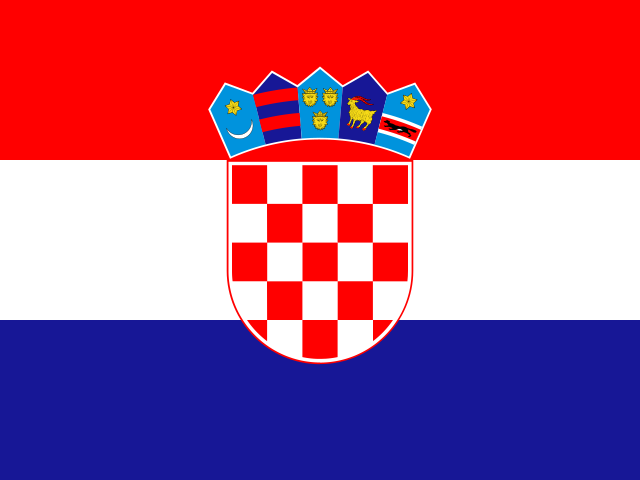
Croatia adopted the euro in 2023 after meeting the EU’s convergence criteria, including requirements on inflation, public finances and exchange rate stability.³
Bulgaria joined more recently, adopting the euro on 1 January 2026.² It became the newest member of the eurozone after several years of preparation and alignment with EU economic rules.
The euro is also used outside the eurozone; **6 small countries and territories also use euro currency, **4 of them with formal agreements with the EU and 2 unilaterally.
Here is a quick overview:
4 European microstates use the euro under formal agreements with the EU:⁴
The agreements lets these 4 independent microstates use the euro as their official currency, even though they are not EU member states or part of the euro area. They can also issue limited quantities of their own euro coins, but not euro banknotes.⁵
Vatican City is one example. It uses the euro under a formal monetary agreement with the EU and can issue euro coins with Vatican designs. These are legal euro coins, but they are minted in small numbers and usually produced by Italy’s state mint.⁶
Kosovo and Montenegro also use the euro without a formal agreement with the EU.⁴ The European Commission describes this as the de facto use of the euro. In practice, this means the euro works as the domestic currency, even though neither country is part of the euro area or has the right to issue euro coins.
Both Kosovo and Montenegro had already moved away from the Yugoslav dinar and were using the Deutsche Mark before the euro was introduced in 2002. Using the euro gave them a more stable and trusted currency, but they do not take part in eurozone monetary policy.⁷
The eurozone does not just cover countries on the European continent. Because France, Spain and Portugal all have overseas territories that are legally part of their countries, the euro travels with them, sometimes to places you would never expect. There is also one very unusual case involving British soil.
The following overseas territories use the euro as their official currency:⁸
All of these are fully integrated outermost regions of the EU, meaning the euro applies there just as it does in mainland France, Spain and Portugal.
The UK uses the pound sterling (GBP) as its official currency, not the euro; however, there is one exception under British sovereignty. Akrotiri and Dhekelia, the Sovereign Base Areas in Cyprus, use the euro as their official currency.⁹
This is not typical across British Overseas Territories. Most do not use the euro and instead use local currencies or currencies pegged to sterling. Gibraltar, for example, uses the Gibraltar pound, which is tied to pound sterling. Akrotiri and Dhekelia are unusual because of their location and close ties to Cyprus, which uses the euro.
Not every EU country uses the euro. As of 2026, 6** EU countries still have their own national currencies:** Denmark, Poland, Hungary, the Czech Republic, Romania and Sweden.
Denmark is the only EU country that** can legally opt out of the euro**, thanks to the Maastricht Treaty. Danish voters turned it down in a 2000 referendum, and most people have been against adoption ever since.¹⁰
**Poland, Hungary, the Czech Republic, Romania and Sweden are all required to adopt the euro **under their EU accession treaties, but none has a fixed deadline. Adoption depends on meeting the EU's convergence criteria covering inflation, interest rates, public debt and exchange rate stability. According to the ECB's 2024 Convergence Report, legislation in five of the six countries assessed was still not fully compatible with the legal requirements for joining.¹¹
Sweden is worth a specific mention. It has no formal opt-out but has stayed outside the euro by not joining ERM II, a required step before adoption. After a 2003 referendum rejected the euro, Sweden has deliberately kept it that way.¹²
The EU countries still expected to adopt the euro are:
None has a confirmed entry date. Unlike Denmark, these countries do not have a formal opt-out, so they are still expected to join once they meet the EU’s legal and economic requirements.¹³
Using euros abroad is usually straightforward, but small choices can affect how much you pay. Here are a few practical tips to help you avoid unnecessary fees and get a fair exchange rate.
When you pay by card abroad, you may be asked if you want to pay in GBP or in euros. It can be tempting to choose your home currency so you know the cost straight away, but that usually means the merchant or ATM applies its own exchange rate. This is called dynamic currency conversion, and it often works out more expensive than paying in the local currency.
Choosing euros instead usually gives you a fairer conversion, especially if your card provider uses the mid-market exchange rate. If you want to spend in euros with fewer extra costs, the Wise account lets you hold and pay in multiple currencies using the mid-market rate.
Learn about the Wise account 🌍
Not all ATMs are the same. Independent or “commercial” ATMs often charge extra fees, especially in tourist areas. If you need cash, try to use ATMs from major local banks instead.
It’s also best to avoid exchanging money at airport kiosks. These often come with higher fees and weaker exchange rates compared to withdrawing cash or paying by card.
Cards are widely accepted across the eurozone, especially in cities and larger businesses. In many places, you can pay by contactless or mobile wallet without any issues.
However, cash is still common in smaller shops, rural areas or for small purchases. It’s always a good idea to carry a small amount of euros, just in case.
If you’re travelling, you can check country-specific guides like “cash or card in Spain” or “cash or card in Germany” to understand local preferences better.
No. The euro is used in 21 EU countries in the eurozone, but not in all European countries. Countries such as Switzerland, Norway and the UK use their own currencies, and some EU countries, including Poland, Hungary and Sweden, have not adopted the euro.
**Bulgaria is the newest country **joining the eurozone. It adopted the euro on 1 January 2026, becoming the 21st EU member state to use it.
No, you should not rely on euros in either country. Switzerland uses the Swiss franc, and Turkey uses the Turkish lira. However, some tourist-facing businesses may accept euros, but prices, change and card payments are usually handled in the local currency.
Yes. Since 1 January 2026, Bulgaria has used the euro as its official currency, so you’ll need euros for everyday spending there.
Sources used:
Sources last checked on date: 7-APR-2026
*Please see terms of use and product availability for your region or visit Wise fees and pricing for the most up to date pricing and fee information.
This publication is provided for general information purposes and does not constitute legal, tax or other professional advice from Wise Payments Limited or its subsidiaries and its affiliates, and it is not intended as a substitute for obtaining advice from a financial advisor or any other professional.
We make no representations, warranties or guarantees, whether expressed or implied, that the content in the publication is accurate, complete or up to date.

Find out how to close a Hargreaves Lansdown account in the UK, including the steps involved, how long it takes and info on account closure fees.

Learn which countries use the pound, which territories are pegged to GBP, and which currencies are independent.

See which countries use the dollar and understand the difference between using the US dollar and having a separate local dollar currency.

Find out how to close a Vanguard account in the UK, including the steps involved, how long it takes and whether there are any account closure fees.

Find out how to close an eToro account in the UK, including the steps involved, how long it takes and info on account closure fees.

Read this for the lowdown on Vanguard minimum investment requirements in the UK, for its General Investment Account and Stocks & Shares ISA.