
Best Business Accounts for Freelancers in Germany
Learn about the best business accounts for freelancers in Germany. Our guide covers features and fees of each provider to help you make an informed decision.



Managing business finances is rarely a one-person task, especially if you run a limited company with co-founders or share responsibilities with partners. That’s where a joint business bank account can help.
Whether you’re launching a start-up, running a small enterprise or overseeing a business with several directors, a joint account can make it much easier to track spending, manage cash flow and collaborate securely.
This guide breaks down how joint business accounts work, why you may (or may not) need one and how different providers compare. Plus, it’ll look at how Wise Business could help you manage your money across multiple currencies.
💡 Learn more about Wise Business
There are many joint business accounts in the UK but they differ in terms of cost, functionality, technology and international capability.
Here are the providers we’ll compare in detail:
| Provider | Monthly fee | Trustpilot rating | Best for |
|---|---|---|---|
| Wise Business | No monthly fee (one-off setup cost) | 4.3¹ | Best for multi-currency, global payments, shared access & automation |
| Starling Business | £0² | 4.2³ | Best for UK-focused businesses wanting a powerful mobile bank |
| Tide Business | £0 base⁴ | 4.2⁵ | Best for fast set-up & financial admin tools |
| Revolut Business | Starts at £10 per month⁶ | 4.6⁷ | Best for international businesses needing extras like cards & analytics |
| Barclays Business | £10⁸ | 3.2⁹ | Best for established businesses needing branch access & lending |
| HSBC Business | Free for the first 12 months¹⁰ | 4.5¹¹ | Best for traditional banking & international trade finance |
A joint business bank account is a specific type of account that can be opened and managed by two or more individuals within a business. This typically includes:
Everyone named on the account has authority to view transactions, make payments and access business funds. But how much access each person has depends on the bank’s permission settings. Some allow full access, whereas others have the option of creating custom roles with limited permissions.
Joint business accounts work in the same way as a standard business account. The main difference is that they’re shared by multiple people. While they offer many benefits to a business, they are often used for companies that want to split financial responsibility and simplify bookkeeping without any bottlenecks.
Not every business needs one but a joint business bank account can be useful if:
- You have more than one director or partner: A joint account provides transparency so everyone can see income, expenses and cashflow at any given time.
- You want shared responsibility: Instead of relying on one person for payments, several people can handle tasks - often boosting efficiency across the business.
- You’re scaling quickly: Growing businesses often need faster approval workflows. Joint access to an account can do this and makes day-to-day operations smoother.
- You deal with lots of suppliers: Joint bank account access can improve tracking and ensure your books are tidy, and ready for audit.
- You want accountability: Many providers allow you to assign permissions and track who made which payment. Often, you are still able to approve high-value transactions, however.
If you’re a sole trader or single director limited company with no additional decisionmakers, a joint account might not be required. But even then, some businesses prefer having one and providing access to their admin and bookkeeping teams. Ultimately, the choice is yours and comparing some of the top providers can help you to find one that best suits your needs.
| 💡 Read more about partnership business accounts |
|---|
Joint bank accounts are designed to make financial management between multiple people easier and clearer. Not to mention, more secure. But that’s not the only advantage of opening one.
- Greater transparency: With a shared bank account, everyone that has access can see transactions and balances. This is not only useful for financial oversight but also helps to avoid misunderstandings.
- Easier accounting: When all partners use one account, it becomes simpler to track cashflow and reconcile. Your accountant will likely thank you too.
- Reduced dependency: If one director is away, someone else can still approve payments and the business continues to run smoothly. \
- Custom roles: Most business accounts allow you to set different permissions. This includes view only, prepare payments, admin and full access.
- Faster operations: Ultimately, joint accounts can help with workflow efficiency - especially when various people need to access funds to do their job.
While individual suitability varies, a joint business bank account can be ideal for those companies that want to stay organised and reduce financial risk.
To evaluate the above providers fairly, we’ll look at them through four lenses:
Wise Business is available to limited companies, partnerships, freelancers, sole traders, non-profits and multi-director set-ups. It offers multi-user access and has various international features. This makes it well-suited for businesses that pay global contractors, receive foreign income or work across borders.
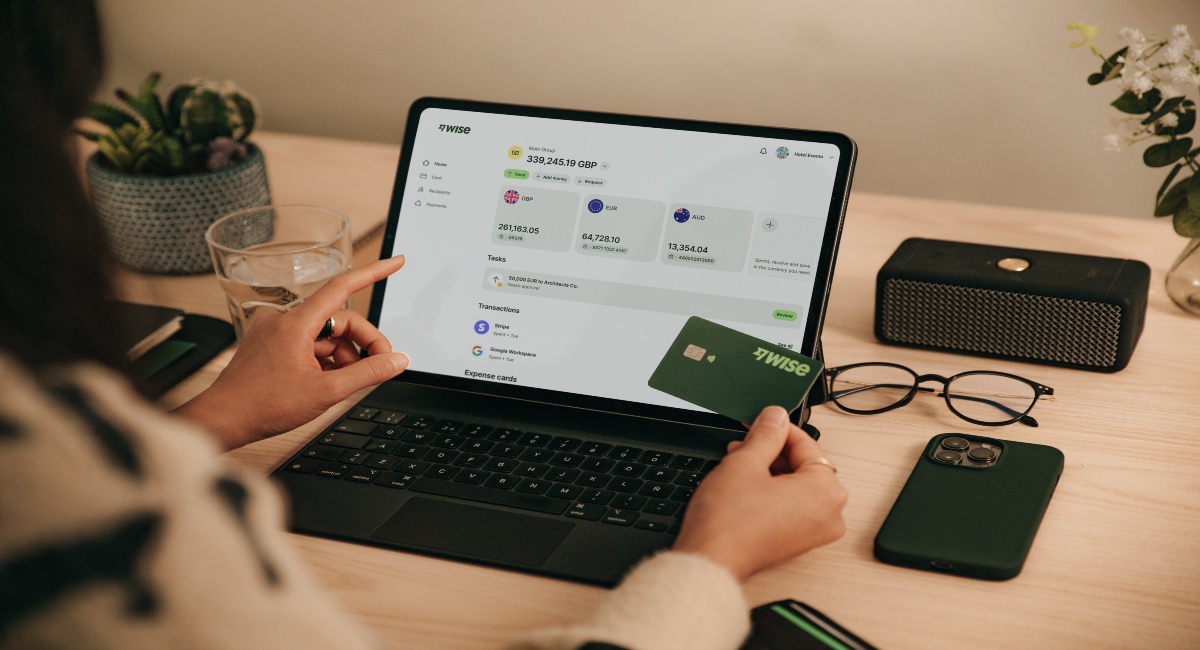
You can add multiple users and assign different roles, making it effective for safe joint account management. As well as this, users can:
Wise Business strengths:
Wise Business limitations:
*Disclaimer: The UK Wise Business pricing structure is changing with effect from 26/11/2025 date. Receiving money, direct debits and getting paid features are not available with the Essential Plan which you can open for free. Pay a one-time set up fee of £50 to unlock Advanced features including account details to receive payments in 22+ currencies or 8+ currencies for non-swift payments. You’ll also get access to our invoice generating tool, payment links, QuickPay QR codes and the ability to set up direct debits all within one account. Please check our website for the latest pricing information.
Starling is a UK digital bank known for its low fees, strong app functionality and clean interface. It offers full digital banking services for limited companies, partnerships and sole traders. Plus, multiple directors can be added.
As well as this, users can choose from physical and virtual cards and enjoy features such as accounting integration and receipt capture and categorisation - which can do wonders for overall bookkeeping.
Starling strengths:
Starling litmiations:
| 💡 See how Wise Business compares to Starling |
|---|
Tide Business is an app-based bank account available for limited companies, sole traders, single person and multi-person set-ups. As well as team cards, users can access invoicing tools, accounting connections and features such as expense categorisation.
There’s also the capability to set spending limits. Payment terminals are available and there are tiered plans for higher transfer limits.
Tide Business strengths:
Tide Business weaknesses:
| 💡 See our full Tide Business review |
|---|
Revolut’s Business Account offers advanced features as well as strong international capabilities. Limited companies, partnerships and registered businesses can apply and there’s the option to set-up multiple account users.
As well as standard business accounts, there is a multi-currency account with both physical and digital cards. Additional features include payroll tools, spending controls and simple integration with Xero, QuickBooks, Slack and Zapier.
Revolut strengths:
Revolut limitations:
| 💡 Read our full Revolut Business review |
|---|
One of the UK’s largest high-street banks, Barclays offers a joint business account option. Limited companies, partnerships and charities are eligible and full ID checks are carried out for all partners and directors.
Some of the most useful features include a business debit card, overdrafts and loans, payment terminals and cash/cheque deposit. There’s also nationwide branches for in-person support.
Barclays strengths:
Barclays limitations:
| 💡 See more about the: Barclays Business account |
|---|
HSBC is another major bank offering joint business accounts. Most business structures are eligible with multi-director access. As well as standard business accounts, there are overdrafts business loans available.
Users have access to specialist relationship managers and global business support. Not to mention, accounting integration.
HSBC strengths:
HSBC limitations:
| 💡 See more about the: HSBC Business account types |
|---|
The right joint business account for you depends on several factors. When choosing between the options, it can be beneficial to consider:
As well as this, it pays to consider whether you require physical or virtual cards, mobile or in-person support and whether you would benefit from overdraft and lending options.
What’s more, it may be beneficial to consult with other potential users so that all needs are met before opening an account.

For teams sharing financial responsibilities, Wise Business offers joint account functionality. Plus, you can:
You can open an account with ease, for £50 (Advanced plan) or for free (Essential plan).
Whenever you need to send, spend or exchange foreign currencies, you’ll benefit from the mid-market exchange rate, with low and transparent fees.
That’s not all either, as when you open a Wise Business account, you’ll benefit from all of these useful features:
This makes Wise especially strong for businesses in the modern age looking to share financial responsibility, send payments abroad and make processes more efficient internally.
*Disclaimer: The UK Wise Business pricing structure is changing with effect from 26/11/2025 date. Receiving money, direct debits and getting paid features are not available with the Essential Plan which you can open for free. Pay a one-time set up fee of £50 to unlock Advanced features including account details to receive payments in 22+ currencies or 8+ currencies for non-swift payments. You’ll also get access to our invoice generating tool, payment links, QuickPay QR codes and the ability to set up direct debits all within one account. Please check our website for the latest pricing information.
It’s quick and easy to open a Wise Business account, with a fully digital application, verification and on-boarding process. Check out the requirements here.
Sources used:
Sources last checked on date: 06-Nov-2025
*Please see terms of use and product availability for your region or visit Wise fees and pricing for the most up to date pricing and fee information.
This publication is provided for general information purposes and does not constitute legal, tax or other professional advice from Wise Payments Limited or its subsidiaries and its affiliates, and it is not intended as a substitute for obtaining advice from a financial advisor or any other professional.
We make no representations, warranties or guarantees, whether expressed or implied, that the content in the publication is accurate, complete or up to date.

Learn about the best business accounts for freelancers in Germany. Our guide covers features and fees of each provider to help you make an informed decision.

Read our in-depth Arbuthnot Latham account review to see if their private banking and wealth management services are for you.
Learn about Cater Allen private banking for businesses, its features and fees, and see if Wise Business could be a simpler alternative.

Learn about the best business accounts for freelancers in Spain. Our guide covers features and fees of each provider to help you make an informed decision.

Learn about the best business accounts for freelancers in Italy. Our guide covers features and fees of each provider to help you make an informed decision.

Explore Wise Business alternatives tailored for your success. Find innovative solutions and strategic options to grow your enterprise today.











