
Foreign resident capital gains withholding: Your guide to clearance certificates
Selling property in Australia? Find out what the foreign resident capital gains withholding tax is, and how to apply for an ATO clearance certificate.





*Pricing claim based on comparative data for select airports and passes. Live pricing is subject to exchange rate fluctuations.
📱Find out how to get lounge access
If you work for a global tech company, a growing startup, or a listed enterprise in Australia, part of your compensation package might come in the form of Restricted Stock Units (RSUs).
While getting a slice of equity in your company is an exciting perk, it often brings a wave of confusion when tax season rolls around. Unlike a traditional cash bonus, RSUs aren't always subject to automated tax withholding by your employer's payroll department, which can lead to unexpected bills if you aren't prepared. This guide breaks down exactly how RSUs work, how they are taxed under the Australian Taxation Office (ATO) rules. We'll also let you know how you can manage your cross-border equity proceeds easily with Wise.
| Table of Contents |
|---|

This guide is for information only. This guide does not constitute tax advice. Tax can be complex, particularly when working across borders. Seek professional advice if you’re unsure what income you need to declare to the ATO, and where you must pay taxes.
A Restricted Stock Unit (RSU) is a form of equity compensation where an employer promises to give an employee a specific number of shares in the future, subject to certain conditions being met.¹ Generally, these conditions are time-based (like staying at the company for a set period) or performance-based.¹
When an employer includes RSUs in your salary package, they are offering you a non-cash benefit designed to align your financial interests with the growth of the company. It functions as an incentive—if the company performs well and the stock price goes up, your overall compensation increases.
Unlike traditional shares, you don’t actually own anything on day one. You hold a promise that will convert into real shares once the restrictions lift.
Understanding how RSUs shift from a corporate promise into actual assets involves three critical milestones:
The grant date is the day your company formally awards you the RSUs.¹ For example, your employer might grant you 400 RSUs. On this date, you don’t own the underlying shares, you have no voting rights, and you don’t receive dividends. There is no tax obligation on the grant date.¹
Vesting is the most important milestone in the RSU lifecycle. This occurs when you fulfill the conditions of the award (such as hitting a time milestone) and the restrictions are lifted.¹
RSUs usually vest according to a schedule (e.g., 25% every year over a four-year period, or monthly after a one-year "cliff"). When a tranche vests, those specific units convert into actual shares in your name.¹ In Australia, the vesting date is generally the point where your tax liability is triggered.
Settlement refers to the actual delivery of the shares into your brokerage account once vesting occurs.¹ In most modern equity plans, vesting and settlement happen almost simultaneously. Once the shares settle, you are free to hold them in your portfolio or sell them immediately on the open market.¹
Equity compensation comes in various structures. Here is how RSUs compare to other common employee share schemes (ESS) in Australia:
| Equity Type | What You Receive | Upfront Cost to You | When Tax is Typically Triggered |
|---|---|---|---|
| RSUs | Actual shares once conditions are met. | None.¹ | At vesting (the deferred taxing point).¹ |
| Stock Options | The right (but not obligation) to buy shares at a fixed "strike price".³ | The pre-determined strike price when you choose to exercise. | Generally when you exercise the options to buy shares.³ |
| Performance Rights | Shares, but only if specific performance or company hurdles are met.³ | None. | At vesting, once hurdles are cleared.¹ |
| ESPPs (Employee Share Purchase Plans) | Shares you buy yourself, typically at a discounted price. | Your own contributions through payroll deductions. | Varies, but often when you buy the discounted shares or sell them. |
In Australia, RSUs fall under the Employee Share Scheme (ESS) tax rules administered by the ATO.¹ ² The core principles you need to know are:
- Vesting is treated as ordinary income: The ATO views the vesting of RSUs as an income event, not just a capital gains event.¹ ³ The market value of the shares on the exact day they vest (less any cost base, which is usually nil for RSUs) is treated as employment income and added directly to your assessable income for that financial year.¹ ³
- No automatic employer tax withholding: This is a common trap for Aussie employees. Unlike your regular cash salary, Australian employers are generally not required to withhold PAYG tax on RSU vests.¹ You receive 100% of the shares, but you inherit 100% of the tax bill at the end of the financial year.
- The 30-Day Rule: If you sell your vested shares within 30 days of the deferred taxing point (the vesting date), the taxing point shifts to the date of the sale.¹ ² Your taxable ESS income will be based on the actual cash proceeds you received from the sale, rather than the stock price on the vest date.¹ ²
- Capital Gains Tax (CGT) kicks in post-vesting: Once your RSUs vest, the market value on that date becomes your cost base for CGT.¹ If you hold the shares and sell them later at a higher price, you will pay CGT on the profit.¹ If you hold the shares for more than 12 months as an individual, you may be eligible for a 50% CGT discount on that profit.¹
To see how this works in practice, let’s look at an example.
Imagine you have 100 RSUs that vest on a day when the company stock is trading at $50 AUD per share. Your marginal income tax rate is 37% (plus a 2% Medicare Levy, making a total tax rate of 39%).
Since your employer doesn't withhold tax at vest, you will need to pay this $1,950 AUD out-of-pocket when you lodge your tax return, unless you sell immediately under the 30-day rule.¹ ²
You decide to hold your 100 shares. 14 months later, the stock price rises to $70 AUD, and you sell them all.
When a vesting date approaches, you generally have three routes to choose from depending on your personal financial strategy and cash flow:
If you decide to resign or your employment is terminated, the treatment of your RSUs depends heavily on whether they have already vested:
Note: For shares or rights issued under employee share schemes, ceasing employment is no longer considered a deferred taxing point by the ATO for any employment ending on or after 1 July 2022.² ⁴
Many global companies manage their equity plans through overseas brokerages. This means when your RSUs vest or when you sell them, your proceeds are typically distributed in foreign currencies like US Dollars (USD). If you wire those US dollars directly back to a standard Australian bank account, traditional banks often hit you with two steep costs such as high international receiving or wire fees, or a hidden markup on the foreign exchange rate, which can quietly eat away a percentage of your hard-earned equity value.
If you are getting proceeds from abroad, you will need a cost-effective way to repatriate your funds back home to Australia. Wise is a simple way to receive money fast and conveniently. Open a Wise account for free; get paid however you like, wherever you are. You will get 8+ domestic account details in global currencies like USD, GBP, and more to receive money like a local.
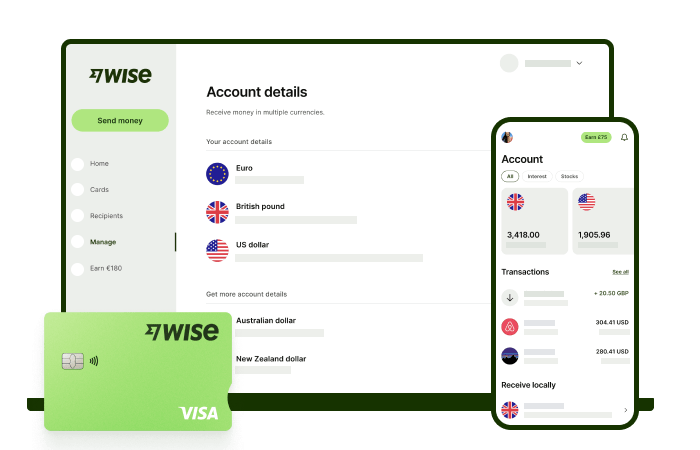
Easily manage transfers through the Wise app by sharing your account details, requesting with the Wise tag or syncing your contacts. After getting your funds, you can hold and exchange 40+ currencies in your Wise account. For all your currency exchanges, you can get the mid-market rate and low, transparent fees, which usually gives the best value for your money. Wise also lets you send money to 140+ countries or get a linked Wise debit card to spend internationally, all at the same great mid-market rate. Plus, you can activate Wise Interest to earn potential returns* on your eligible balances while keeping your money available to spend.
When it comes to international transfers, Wise makes things easier and cheaper.
*Growth is not guaranteed. Capital at risk. Interest is the name of a custody and nominee service provided by Wise Australia Investments Pty Ltd in partnership with Franklin Templeton.
Please see Terms of Use and product availability for your region or visit Wise Fees & Pricing for the most up to date pricing and fee information.
You are taxed when a deferred taxing point occurs, which for RSUs is almost always the vesting date (when the restrictions lift and you receive the shares).¹ ³ You must declare this income on the tax return for the financial year in which the vest occurred.¹
Your employer is required to provide you with an ESS Statement by 14 July following the end of the financial year.² This statement outlines the taxable value of your RSU vests.² The ATO usually pre-fills this data directly into your online myTax portal, but it is your responsibility to double-check its accuracy before submitting.²
Generally, no. In Australia, employers do not automatically withhold PAYG tax from your RSU vests.¹ You must plan ahead and ensure you have saved enough cash to pay the income tax when you file your annual return.
Sources:
*Please see terms of use and product availability for your region or visit Wise fees and pricing for the most up to date pricing and fee information.
This publication is provided for general information purposes and does not constitute legal, tax or other professional advice from Wise Payments Limited or its subsidiaries and its affiliates, and it is not intended as a substitute for obtaining advice from a financial advisor or any other professional.
We make no representations, warranties or guarantees, whether expressed or implied, that the content in the publication is accurate, complete or up to date.

Selling property in Australia? Find out what the foreign resident capital gains withholding tax is, and how to apply for an ATO clearance certificate.

Wondering how much foreign income is tax-free in Australia? Learn how the ATO treats worldwide earnings, foreign tax offsets (FITO), and tax residency rules.

Learn how to link and transfer your AMEX Membership Rewards points to your Qantas Frequent Flyer account, check transfer ratios, and maximise your points.

Is the Amex Explorer card worth it? Our review dives into the benefits, lounge access, insurance, and fees.

Compare the best AMEX cards for points in Australia. Discover AMEX cards for Qantas points, travel rewards, and sign-up bonuses to maximise your spend.

Learn how to check, redeem, and use your AMEX travel credit in Australia.











