
The dual-base dilemma: How Hungarian founders are building for the world
Hungary's startup ecosystem is on the rise but for many founders, the domestic venture capital market isn't keeping pace. Increasingly, Hungarian founders are...


There comes a time in almost every startup’s journey — whether in the UK, Europe or further afield — when its executive team considers expansion to the United States (US).
Why? The US remains the world’s largest consumer economy, hosts the world’s most prolific venture capital (VC) industry and for many businesses, offers unparalleled growth opportunities.
Despite making up less than 5% of the world’s population, US consumers represent 30% of global spending and in 2025, US VC investment reached nearly $340 billion.
While it has never been easier to operate a business across borders, breaking into the American market — and navigating its regulations as a founder, financial or hiring manager — remains a significant challenge.
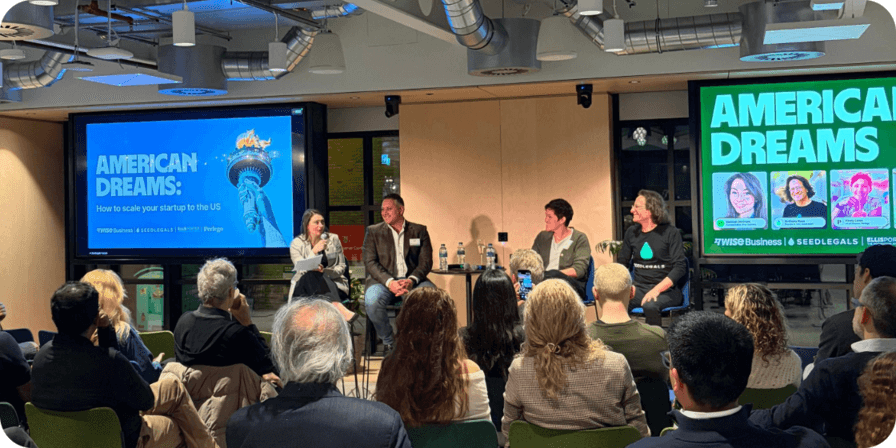
To help startups navigate US expansion, we hosted a panel discussion with experienced expansion experts, including Anthony Rose, Founder at SeedLegals, Kirsty Lowe, VP of Finance at Perlego, Arvinder Ubhi, Partner at Ellis Porter hosted by Hannah McGrath, Business Content Lead at Wise.
The panel, titled ‘American Dreams: How to expand your startup to the United States,’ covered everything from creating a successful go-to-market strategy to moving your executive team to the US and managing your business’ finances in multiple currencies.
We’ve compiled the key takeaways from the session below. If you’d like to watch the session, you can view it on YouTube here.
| Meet the panellists | |
|---|---|
| Anthony Rose, Co-founder & CEO, SeedLegals | Known as “The man behind BBC iPlayer”, Anthony Rose is a seasoned entrepreneur and the driving force behind SeedLegals, the platform powering a third of all early-stage SEIS/EIS funding rounds in the UK. With a background in internet video, P2P tech, and social platforms — plus a patent portfolio spanning content discovery and interactive TV — Anthony brings a rare mix of technical depth and commercial know-how to the startup world. |
| Arvinder Ubhi, Partner, U.S. Expansion Team | Arvinder is a Partner, and he leads the US Expansion practice team from Ellis Porter’s London, UK office. Arvinder worked with Ellis Porter in the US as an immigration attorney from 2012-2015, and he rejoined Ellis Porter after working for two Big Four accounting firms as a US immigration attorney in Toronto, Canada. In these roles, Arvinder managed a high volume of employment-based work visa and green card cases for large, multinational corporations. |
| Kirsty Lowe, VP of Finance at Perlego | Kirsty is responsible for overseeing Perlego’s growth as it scales its digital library of more than a million books to over 190 markets globally. Perlego recently closed a Series B bridge round. Prior to joining Perlego, Kirsty was the FinOps Lead at Quantico where she led the finance function across a range of dynamic startups, including building financial plans and scalable systems that support high growth businesses, and Head of Finances and Operations at Enjoy Education. Perlego uses Wise Business to manage multi-currency finances in the US and UK. |
Hannah kicked off the panel with a question for Arvinder: “What are the most common reasons companies reach out to you looking to expand their business stateside?” To which he didn’t hesitate to respond, “Money. It’s pretty simple.”
As a lawyer and expansion expert, Arvinder constantly speaks to businesses that are hoping to expand in a market that is "significantly larger than the UK and Europe combined or are looking for investment.” The challenge is knowing the right time to enter the US.
For Kirsty and her team at Perlego, that time has come. While they’ve managed to raise capital and scale their operations globally from their London HQ, the US market is a growing priority. After establishing that they had “a strong product-market fit in the UK,” Kirsty said, “We expanded into the US, as many people do, both for the purchasing power and also the scale of the market. Particularly in the education space, the US is a market which puts a very high value on education. It’s something they are willing to spend quite heavily on.”
Once a business has determined their case for US expansion, it’s time to create a go-to-market strategy — a process that can be particularly difficult in a region as complex as the US.
After seven years of successful operation in the UK and EU, Anthony and his team at SeedLegals started to look beyond their home region. Once they realised that the technical effort of expanding to a small country would be the same as a big country, they decided to expand to the US.
Now, splitting his time between London and New York City, Anthony has a good grasp on what it takes to break into the US market. On the panel, he broke this down into four levels:
Level 1: Test the market digitally without leaving the UK
Level 2: Hire specialised contractors or consultants through your UK entity
Level 3: Set up a US subsidiary once you need to hire full employees
Level 4: Perform a ‘Delaware Flip’ to raise money with US investors
Anthony recommends this strategy because it starts slow and requires little capital investment as you test out market entry. For levels 1 and 2, “No one leaves the country, no setting up anything; you just enable it in the US. That’s great; your cost is zero to do it.” With this leveled approach, capital and time expenditure only increase as your confidence in your business’ success in the market does.
Arvinder seconded this approach, saying:
“most of our clients who are really successful and able to stay in the US and grow are those that have been selling their goods or services there for probably 6 to 12 months already. They’ve already got really good traction, they’ve got some existing clients in the US — they are typically the ones that are going to be able to make it work.”
Kirsty and her team at Perlego have benefitted from this strategy firsthand:
“I think one of the benefits nowadays, is the scale that you can actually achieve without having to physically be present.” She added, “we were in a strong position to actually validate without having to make that commitment.”

Once you have a need to hire with the US (Level 3), Anthony emphasised that setting up a US subsidiary is essential for a few key reasons, “One, having your US operation through a US company contains any legal issues. Two, you ideally don’t want to create a tax entity or presence, and by creating a C-Corp in the US, you can contain that as well. And three, to employ people in the US.” While the prospect of setting up a US subsidiary can seem intimidating, the process is made easier with tools like SeedLegals, where you can “get set up for just $500.”
A ‘Delaware Flip’ however — a legal restructuring process where a UK company sets up a new Delaware C Corp as its parent company — is only essential when raising investment. Anthony pointed out that investors look for a Delaware C Corp for a few reasons, “One, they're familiar with the law. Two, in the same way we’ve got SEIS (Seed Enterprise Investment Scheme) and EIS (Enterprise Investment Scheme) here, they’ve got something called QSBS (Qualified Small Business Stock) there.” Most importantly, completing a Delaware Flip means “removing friction” for investors and creating a more enticing case for investment in your business.
While establishing a Delaware C Corp means your business is ready to raise money from anywhere in the US, Kirsty and Anthony both agreed that viewing the country as one market can be a pitfall. Kirsty noted:
“It’s not just a country and one-market; it’s almost 50 little countries with slightly different rules and quite strong consequences if you overstep those very firm boundaries, both from a legal, tax, nexus and employment perspective.”
For many businesses, hiring is one of the most complex, expensive and time consuming aspects of expanding the US. For one, talent in the US is expensive. The average salary for a Chief Marketing Officer in the US is $373,365 per year, while in the UK it’s £187,500 or about $253,335.
Hiring Americans in the US isn’t as simple as employing from your UK entity, instead, Arvinder recommends exploring ‘Employer of Record’. An Employer of Record or EOR is a third-party organization that can legally employ workers abroad on behalf of your business. Arvinder notes, “From an ease and ability to just hire in the US, Employer of Record makes sense for a lot of companies. And we have lots of clients who will use that initially.”
For Kirsty and Perlego, hiring in the US via an EOR has been the best bet but it hasn’t always been straightforward. “We’ve been quite intentional with the states where we put people because you can very quickly build up a whole bunch of nexus that you didn’t know existed by having people there, or someone tells you "Oh, by the way, I’m just moving to Texas," and what they don’t realize is there are significant consequences to that.”
While an EOR can help businesses get their US teams started, it won’t work when they want to move their CEO or executive team to the US. Arvider noted, “From an immigration perspective, it’s not going to work. If you're looking to have the CEO or exec team go out to the US and operate there, you cannot have an Employer of Record sponsor those individuals for work permits. They need to be directly hired from your US entity.”
Despite the effort associated with this process, Arvinder says it’s worth it:
“We’ve found that most of the clients who succeed in the US, it’s because they’ve transferred or implanted some of their key individuals—particularly at the executive/founder level—who know the product, the culture, the values of the company, and they’re able to distill them to that US team as they grow it out.”
While moving part of your executive team to the US can be incredibly positive for your business, recent changes to immigration policy have made it increasingly difficult to secure visas.
Arvinder was quick to point this out, “the big elephant in the room is that immigration is tough right now. I think everyone’s probably seen news articles; it is real. We are not trying to hide behind the fact that there have been changes. Immigration is more difficult than it has been in prior years.”
But that doesn’t mean it’s impossible. Arvinder added, “there is still a formula to it. The immigration laws generally haven’t changed since the 1970s so we use our wealth of experience to help navigate that process as best we can. What we’re recommending to all of our clients is: speak to us early and often. If you are looking to expand to the US, it is not as easy as moving to some other countries where they have short-term work permits you can apply for at the border.”
Anthony is a testament to this. As SeedLegals prioritised the US, it was important for Anthony to move to there. Figuring out his visa requirements was one piece of the puzzle, the other was determining where to get set up. Anthony recommends going to the US first:
“I’m surprised by how many people haven’t been to the US and are trying to launch a business out there. So the first thing I say is: jump on a flight, go to the East Coast, go to the West Coast, go North, go South, and just see what you like. Spend a bit of time there.”
Only then, consider “Do you have a nexus between your clients or your products that drives you to a particular region?” Otherwise, Anthony noted “The other thing that people don’t factor in is the time difference. If you’re running a UK or European company and you have a team on the West Coast, that is brutal. You’re a full business day behind or ahead of them. If you’re trying to scale a business and grow a business and you’ve got two feet, one in the UK, one in the US, that time difference is hard. Jumping on a seven-hour flight to New York is very different to an 11-hour flight to San Francisco.”
Whether or not you’re moving to the US, it's never been easier to manage your business’ finances in multiple currencies. Both SeedLegals and Perlego rely on the Wise Business account to get paid, pay their overseas staff using Wise Business’ BatchTransfer and manage their business’ money in GBP, USD and more.
For Kirsty, Wise Business is a no-brainer as she scales Perlego. She notes:
“we operate in 190-plus countries because of both the D2C and the B2B side of the business. It means we have over 10 currencies that we accept payment in. We are a Wise Business customer, and we have found that really valuable for having our core functional currency accounts in terms of pounds, euros, and dollars, which allow us to sort of have that ‘bank presence’ without the physical entity, which means that we can accept in those currencies as well as individual providers and also make payments in those in quite a hassle-free way. That’s a core part of our treasury and operational day-to-day.”
This has been especially critical to the Perlego team as they scale their US operations from the UK. With Wise Business, Kirsty didn't have to set up a US entity, she simply set up some US account details and is able to function from a finance perspective like a local company.
For Anthony, the Wise Business account has taken one aspect of expansion off his plate. He even relies on the Wise Multi-Currency Card for his daily business expenses, saying:
“every time I go on the subway in New York and I tap on Apple Pay to pay, I know that $2.90 is going to be $2.90, not $5 from a high-street bank.”
There’s one thing that all the panellists agreed on — expanding your business to the US isn’t straightforward but with the right partners and the right tools, it’s an incredible market for business expansion. On the whole, businesses haven’t forgotten this and changes to the landscape aren’t stopping businesses from expanding there. Arvider noted, “There are some companies and founders for whom the US is the biggest market, and regardless of what happens, their clients and investors want them there and they will go through whatever they need to get there. That’s still the largest pool of customers.”
Still looking to learn more about US expansion? You can watch the full-length panel on our YouTube here.
Considering scaling your business to the US?
Create a Wise Business account
*Please see terms of use and product availability for your region or visit Wise fees and pricing for the most up to date pricing and fee information.
This publication is provided for general information purposes and does not constitute legal, tax or other professional advice from Wise Payments Limited or its subsidiaries and its affiliates, and it is not intended as a substitute for obtaining advice from a financial advisor or any other professional.
We make no representations, warranties or guarantees, whether expressed or implied, that the content in the publication is accurate, complete or up to date.
Hungary's startup ecosystem is on the rise but for many founders, the domestic venture capital market isn't keeping pace. Increasingly, Hungarian founders are...

A comprehensive guide to employee relocation, including how relocation packages work, UK costs, tax considerations and best practices for staff support.

Learn how to structure and manage relocation packages, including costs, policies, implementation steps and global considerations for employers in the UK.

In today’s economy, there’s one thing business owners can be certain of: uncertainty. Volatility has fundamentally changed the way businesses operate. And...

Compare Revolut GlobalHire and Papaya Global across features, pricing and payroll capabilities to find the right solution for your business.

Learn how much it can cost to outsource social media in the UK. Our guide explains average rates, pricing models, cost drivers, and more.











