LLCs for Non-US Residents (Complete Guide)
Learn how UK residents can form and manage a US LLC remotely. Our guide covers state costs, tax, banking, compliance and Wise Business payment support tips.


Startups today have never faced tougher competition. With investor expectations as sky high as valuations, nearly 20% fail because they are outcompeted and 17% shutter because their products don’t meet customer expectations. As the stakes get higher, creating a viral product is becoming an increasingly critical measure of success.
So what can founders do to get it right? And how can you maintain momentum even after your product’s gone viral?
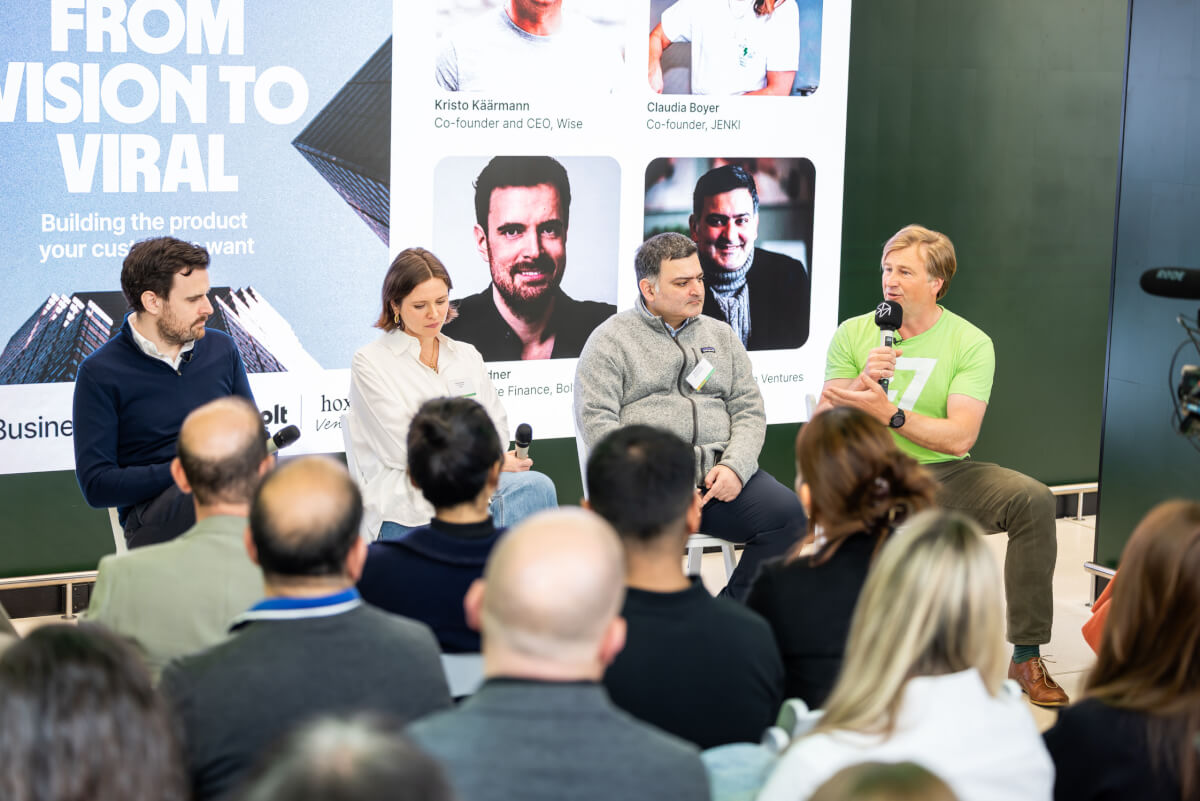
To help businesses answer these questions, Wise’s co-founder and CEO, Kristo Käärmann hosted a panel with David Gardner, VP Corporate Finance at Bolt, Claudia Boyer, co-founder at JENKI and Rishabh Kaul, Venture Partner at Hoxton Ventures at Wise’s temporary Branch on Oxford Street.
The panel, titled ‘From vision to viral: building the product your customers want’ covered everything from the power of customer feedback, to the importance of product and the double-edged sword of virality.
We’ve summarised key takeaways from the session below.

| Meet the panellists | |
|---|---|
| Kristo Käärmann, Co-founder and CEO at Wise | Kristo co-founded Wise in 2010 and holds the position of Chief Executive Officer. Prior to that, he was a consultant at Deloitte and PwC. Kristo holds an MSc in Mathematics and Technology from the University of Tartu. |
| David Gardner, VP Corporate Finance at Bolt | David is Vice President of Corporate Finance at Bolt, where he is responsible for M&A, Equity, Debt Capital Markets, Investor Relations, and Treasury. He was previously Head of European Internet Equity Research at Morgan Stanley, following various roles within the firm’s Investment Banking Division. David also brings buy-side experience from Schonfeld, where he invested in Global Technology companies. |
| Claudia Boyer, Co-founder at JENKI | Claudia co-founded JENKI in 2021 and has redefined the matcha ritual of Londoners with six iconic matcha bars across Selfridges, Spitalfields, Covent Garden, Borough Market, Canary Wharf and Battersea Power Station. Prior to JENKI, Claudia worked in marketing for D2C brands. |
| Rishabh Kaul, Venture Partner at Hoxton Ventures | Rishabh is a Venture Partner at Hoxton Ventures. He previously co-founded Belong, an enterprise HR tech platform backed by Sequoia Capital and Matrix Partners. He’s an active angel investor in over 25 startups in Europe, US and India and runs Svagat - a community of Indians in tech in Europe. |
Most founders dream of going viral, and for good reason — it's powered the success of some of the world's most iconic startups, from Meta and Duolingo to Liquid Death. But virality rarely happens by accident. Fifteen years into building Wise, Kristo knows this better than most. His advice? Let your customers do the talking.
With 18 million active users worldwide, Wise has built a product that customers genuinely recommend to friends, family and business associates. So much so that Kristo shared “60% of new Wise customers join because someone recommended it.” Plus, Wise has stayed ahead of the curve, “we might have been the first ones to discover this in financial services. (...) It led us to build one of the largest tech companies in Europe — mainly because people talk to each other and recommend Wise.”
Wise’s word-of-mouth movement started small. In the earliest days of the company, Kristo and his team launched an invite programme with no incentives, just a link with a customisable comment box:
“Customers could say, ‘Hey David, here’s Wise, it's pretty awesome.’” Each recommendation landed in Kristo's inbox so he could see why customers recommended the product. These insights shaped Wise’s marketing strategy, “A lot of what we do is trying to listen to how our customers naturally would talk to their friends, their family about Wise, and then amplify that in paid marketing.”
At JENKI, Claudia and her husband Otto took a different route to virality with the same core instinct: keeping customers at the centre of their strategy. After launching in 2021, they set out to replicate how “coffee played a part in people's daily routines” but without the jittery after-effect. The challenge was changing public opinion. Most people in the UK had a negative first experience with matcha — whether it was bitter, lumpy or badly prepared.
Claudia's strategy was experience-led: "We developed our menu to be familiar for the coffee drinker," she explained, "but what hadn't been considered before was the experience of purchasing matcha. We always freshly whisk our matcha in front of you, and you get a very personal experience from our passionate team." Plus, there's the social value of a bright green drink and matcha being whisked just for you.
"Matcha is a very instagrammable product," Claudia noted, "and it hadn't been positioned in that way prior to JENKI landing in London."
This cultural hype paired with Claudia’s careful strategic thinking has fueled JENKI's ongoing virality. So much so that its matcha bars regularly have lines that circle the block.

Other times, virality isn't engineered — it's earned. For David and the team at Bolt, popularity was a natural side effect of improving service in an established industry: “The existing legacy taxi market was a pretty poor product with pretty poor service. Pricing was opaque, car quality varied, there weren't many payment alternatives, and you had to be at a taxi rank to pick one up.”
Bolt’s founders started the business ”by knocking on windows trying to get taxi drivers to sign up to an app.” Fast forward to today and the company is mainstream. David shared that Bolt “now operates in over 50 countries and 850 cities,” which account for some “12 billion euros of volume a year and a million people on our platform earning every day.”
That doesn’t mean it’s always been easy. David remembers, “If we go back four or five years in London, there were eight or nine players and now there's essentially two.” David shared that prioritising their community has played a big part in Bolt’s enduring success:
“One of the most important things to remember is that drivers and consumers talk to each other.” If consumers are asking for Bolt, it’s likely drivers will look into it and sign up. “Whether it's Reddit forums, Telegram groups or WhatsApp groups, if you can get that sign-up cycle right and you can get that virality right, it means that your sign-ups are relatively low cost and relatively quick.”
Achieving critical mass has been essential to Bolt’s success. “Customers ride more, so drivers get more rides, they earn more, then we have to discount less, we have to subsidize the customer less, and that's essentially how you take the business through to profitability over time.” But hitting critical mass takes time and sometimes, multiple attempts. For Bolt, Helsinki proved particularly challenging. Despite being “geographically very close to Tallinn,” David shared that it took “three attempts to get it right.” The first two times, they pulled back fairly quickly but when they relaunched the third time, “It went viral. It was the perfect mix of customers wanting a new product and drivers signing up quickly.”
Kristo echoed the same lesson from Wise's experience in Brazil. After launching with just “transfers to Brazil” Wise extended their offering in the region with “transfers from Brazil” — that’s when “it took off massively.” “We were reminded that this is a country of 200 million people,” Kristo shared. “If you're a Brazilian working in London sending money home, you probably have other Brazilians who are sending their kids to school in London or the US.”
Virality isn't just founders’ ambition, it can also be one of the most promising early signals of success for investors. As an investor and former-entrepreneur, Rishabh says:
“At the pre-seed stage, you may not have revenue. So as you take each step back one by one, you end up at all these different proxies and the strongest of them is word of mouth.” He notes, “if there have been enough cases where I've just been online on different forums — whether it's developer tools, Hacker News or the Play Store — and I come across a product that users are talking about, it’s like I have to meet this person. And just hope that I'm not too late and they're not raised a bunch of money already.”
That said, your numbers still matter. They should just be part of a “broader story.” Rishabh explained, “Nobody is going to invest because you showed 20% growth over the last couple of weeks. That's not what they care about, what they care about is what are you really building because this is going to be a marathon.”
Which metric should you lead with? Rishabh recommends retention, “retention can show up in different ways. For consumer companies you have different ratios. As a B2B business, you’re looking for usage. These are early indicators that you can go sell.”

Going viral can make your business. It can also break it if you're not ready.
David knows this firsthand. For a network-effect business like Bolt, virality only works if the platform does. "If you're going to try and create some kind of viral moment, you want the product to back it up so you can then start to compound growth further."
Naturally, this can take some trial and error. David shared his own experience launching Bolt’s food delivery business. They found that customers were churning not because delivery was slow, but because the estimates were too optimistic.
"One of the very first tweaks we did was we just changed the delivery time to say your food's going to be there in 20 minutes and all of a sudden everyone was happy that it came five minutes early.” He explained, “Virality works both ways and you’ll need to manage expectations."
For Claudia, knowing and understanding your audience and where they’re at on the adoption cycle is essential to avoiding losses. When JENKI has “been too far ahead of the wave and the education isn't there yet” they’ve found that they “haven't quite landed the product.” They’ve managed to avoid this by being reactive and linking their products to “a cultural moment.”
Plus, the fact that JENKI produces everything in-house gives them the freedom to “react directly to our customers and their feedback.” For Claudia, this direct line to the customer isn't just a nice-to-have, it informs their entire product strategy.
Going viral is one thing but staying relevant afterward is the true challenge. When an audience member asked the panel how they've kept the momentum going, they each shared distinct strategies.
For David, the formula is quite simple:
“Virality comes from the product. If you have a good product and a good service, people will talk about it.” At Bolt, sustaining excitement has meant staying tuned in to what their drivers and riders are saying. He and his team are always “listening to the friction points” to uncover “what’s stopping a driver from signing up to us if they were going to sign up to another ride-hailing app?”
Bolt also leverages learnings from other markets to sustain growth. David shared, “One of the things that we've got right is having a playbook that you can refine and repeat every time you launch a new product or market.” In practice, this means honing in on metrics like “time to scale, improvement in pricing and speed to profitability.” This data and “more importantly insight into why something doesn't work” is essential to sharpening your strategy on the next launch.

At JENKI, Claudia says customer clarity and product quality are essential:
“We're communicating with our customers often, really listening to what they want and need.” This has enabled the brand to “really differentiate and highlight our differences” with tuned-in seasonal drops and flavours that drive virality on social media. This strategy is clearly paying off — some of JENKI’s matcha bars record customer retention rates as high as 95%.
Rishabh says founder self-awareness is essential — you need to know "how an industry is evolving and the role that you are going to play. Trying to do everything all the time becomes challenging.” He also pointed out that founders are spending too much time on the wrong competition:
“Say you're a startup and you suddenly notice you have five other competitors at a similar stage. As founders it's very easy for us to fall into that trap — but that's not your competition. Your competition is the 800-pound gorilla.” Rather than spending time trying to beat these businesses, founders need to stay focused on incumbent providers, their customers and their mission.
Making smart investor decisions can also help, “It's really important to find the right partner. This is going to be a 10-15 year, maybe even beyond, kind of partnership.” That could mean turning down more money, “The best deals are ones where it stings a little bit for both parties but they're still happy that, you know, we're in this together.”
David, Claudia, Rishabh and Kristo all operate in very different worlds but when it comes to virality, their experiences have clear parallels. Going viral can open doors for your business but it's what you do next that determines your success. If you back up your business model with the right products, the right infrastructure and an unfailing focus on your customer, your viral moment can become the launchpad for a business that lasts.
Want to hear more from our panellists? You can watch the panel in full on YouTube.
Whether you’ve gone viral or are just launching your startup, Wise Business has all the tools you need to start operating in 40+ currencies. Receive payments from investors overseas, extend your runway with Wise Interest, create multi-currency debit cards for your team and more — all from one easy to use account.

Ready to get started?
Create your Wise Business account
*Please see terms of use and product availability for your region or visit Wise fees and pricing for the most up to date pricing and fee information.
This publication is provided for general information purposes and does not constitute legal, tax or other professional advice from Wise Payments Limited or its subsidiaries and its affiliates, and it is not intended as a substitute for obtaining advice from a financial advisor or any other professional.
We make no representations, warranties or guarantees, whether expressed or implied, that the content in the publication is accurate, complete or up to date.

Learn how UK residents can form and manage a US LLC remotely. Our guide covers state costs, tax, banking, compliance and Wise Business payment support tips.

Hungary's startup ecosystem is on the rise but for many founders, the domestic venture capital market isn't keeping pace. Increasingly, Hungarian founders are...

A comprehensive guide to employee relocation, including how relocation packages work, UK costs, tax considerations and best practices for staff support.

Learn how to structure and manage relocation packages, including costs, policies, implementation steps and global considerations for employers in the UK.

In today’s economy, there’s one thing business owners can be certain of: uncertainty. Volatility has fundamentally changed the way businesses operate. And...

Compare Revolut GlobalHire and Papaya Global across features, pricing and payroll capabilities to find the right solution for your business.