
How Does Marketplace Payment Processing Work? A Quick Guide for UK Businesses
Learn how marketplace payment processing works for UK businesses. Our guide explains associated fees, how to optimise payouts, and more.



Ecommerce payments are coming to Wise soon. Click below to register your interest and we'll notify you once it's available.
Selling to customers in the US, EU, or anywhere beyond the UK can mean getting paid in foreign currencies using a multi-currency payment gateway. But how exactly do these types of payment gateways work and what should you watch out for when using them?
We’ve answered these questions and more in this guide, covering what a multi-currency payment gateway is, how it works, and why it's worth considering if your business trades internationally.
We’ve also explained how Wise Business can help with multi-currency transactions - giving you the ability to receive and hold payments in 40+ currencies then convert them to GBP at the mid-market rate with low, transparent fees.
*Disclaimer: The UK Wise Business pricing structure is changing with effect from 26/11/2025 date. Receiving money, direct debits and getting paid features are not available with the Essential Plan which you can open for free. Pay a one-time set up fee of £50 to unlock Advanced features including account details to receive payments in 22+ currencies or 8+ currencies for non-swift payments. You’ll also get access to our invoice generating tool, payment links, QuickPay QR codes and the ability to set up direct debits all within one account. Please check our website for the latest pricing information.

| Topic | Notes |
| 🌍 What is a multi-currency payment gateway? | It is technology that processes international payments and allows you to settle and hold funds in the customer's original currency rather than forcing a GBP conversion. |
| 💱 Is "accepting" currency the same as "settling" it? | No. Many gateways "accept" foreign cards but still convert the money to GBP on arrival. Some providers apply markups above the mid-market rate to this conversion.3 |
| 🛒 Does currency affect my checkout conversion? | It can. Customers are 17% more likely to abandon their cart if they aren't shown prices in a currency they recognise and trust.4 |
| 🛡️ What compliance features are essential? | You must ensure the gateway supports 3D Secure to meet Strong Customer Authentication (SCA) requirements for UK and EU transactions. |
A multi-currency payment gateway processes online payments when a customer checks out on your website in a way that lets you accept payments in your customer's currency and settle those funds into a matching currency account.
It captures their card or payment details, sends them to the relevant bank or payment network for authorisation, and settles the funds into your account.
Many gateways default to settling in GBP unless configured otherwise, which means any payment made in a foreign currency gets converted before it reaches you, often at a rate set by the gateway provider and with a fee attached.
A multi-currency payment gateway works differently, so that if a customer in Germany pays you in EUR, it shows as EUR rather than being converted on the spot.
You can choose when and whether to exchange the EUR, giving you more control over your costs.
When a customer reaches your checkout, the gateway detects their preferred currency and presents prices accordingly.
They complete the payment in their local currency, the gateway routes the transaction through the appropriate card network for authorisation, and the funds are settled into your designated currency account.
The automatic conversion step is deferred, so you can choose when to convert.
This matters a lot when you consider UK cross-border ecommerce sales grew 4% year-on-year recently1 and cross-border transactions are estimated to account for 12% of the UK's total ecommerce2.
For a growing number of UK businesses, a meaningful share of revenue is coming from overseas customers, and forced conversions may reduce margins over time.

With a standard payment gateway, foreign currency payments typically go through a conversion before they reach you, and that conversion has a cost.
Some providers add a markup above the mid-market exchange rate every time a currency gets converted3.
That might not seem like much on a single transaction, but across hundreds of international orders, it will take a huge chunk of your profit. A multi-currency gateway removes that automatic conversion entirely.
For instance, the USD payment stays as USD, and you can convert when it suits you, ideally when rates are in your favour. It shifts currency management from something that happens to you to something you control.
Getting someone to your checkout is the hard part. Losing them there because they don't recognise the currency or can't pay the way they prefer is the frustrating part. Some research suggests checkout conversion rates can decline by as much as 17% when shoppers don't see what they expect4.
For a UK business selling to customers in the US, Germany, or Australia, that is a meaningful amount of revenue that was already within reach. The product was good enough, the price was competitive enough, they just didn't trust what they were being charged.
Most businesses focus on the customer-facing benefits and miss this one entirely.
If you source products from a European supplier and you also sell to European customers, the EUR you receive from customers can go straight towards paying that supplier, without ever being converted to GBP and back again. Every conversion costs you on both ends.
According to some research, more than half of UK SMEs trading in foreign currencies reportedly lose an average of £53,000 due to exchange rate losses5. A lot of that comes not from single large transfers but from dozens of small, avoidable double conversions over time.
If your gateway converts everything on the day it arrives, your effective margins on international sales shift with the market whether you like it or not.
Holding funds in their original currency gives you a natural buffer. When you do convert, you can choose the timing rather than leaving it to chance.
This matters particularly for UK businesses selling into the US or eurozone, where sterling fluctuations can swing profit margins noticeably on any given week.

Most gateways will tell you they support multiple currencies. Fewer will volunteer that there's a difference between accepting a payment in USD and actually settling it in USD.
That distinction is what separates a gateway that saves you money from one that just looks like it does. Here’s what to consider when choosing a multi-currency payment gateway:
Read the fine print before you sign up. A lot of gateways display prices in multiple currencies at checkout but still force-convert everything to GBP the moment it hits your account.
What you want is a gateway that holds funds in the currency they arrived in, so you control when and whether to convert.
Transaction fees are only part of the picture. On top of that, you've got the FX spread above the mid-market rate, plus any monthly fees or per-payout charges.
A gateway with a lower transaction rate but a 2% conversion markup can easily end up more expensive than a pricier one that settles without converting.
Don't go by total currency count. Check whether the gateway covers the specific currencies your customers use. For most UK businesses selling internationally, EUR, USD, and AUD will matter far more than a long list of currencies you'll never touch.
Flat-rate pricing is easier to forecast, especially at lower volumes. Interchange-plus can work out cheaper at scale, but the per-transaction cost shifts depending on card type and region, making it harder to predict until your transaction patterns are consistent.
Start with PCI DSS certification and 3D Secure support. 3D Secure is commonly used to meet Strong Customer Authentication (SCA) requirements under PSD2 in the UK and EU. Any gateway without it may create compliance issues when processing European cards.
Built-in fraud detection matters more when you're selling cross-border, where chargeback rates are typically higher than domestic transactions.
For a full breakdown of top gateway providers for UK startups, we've covered them here.
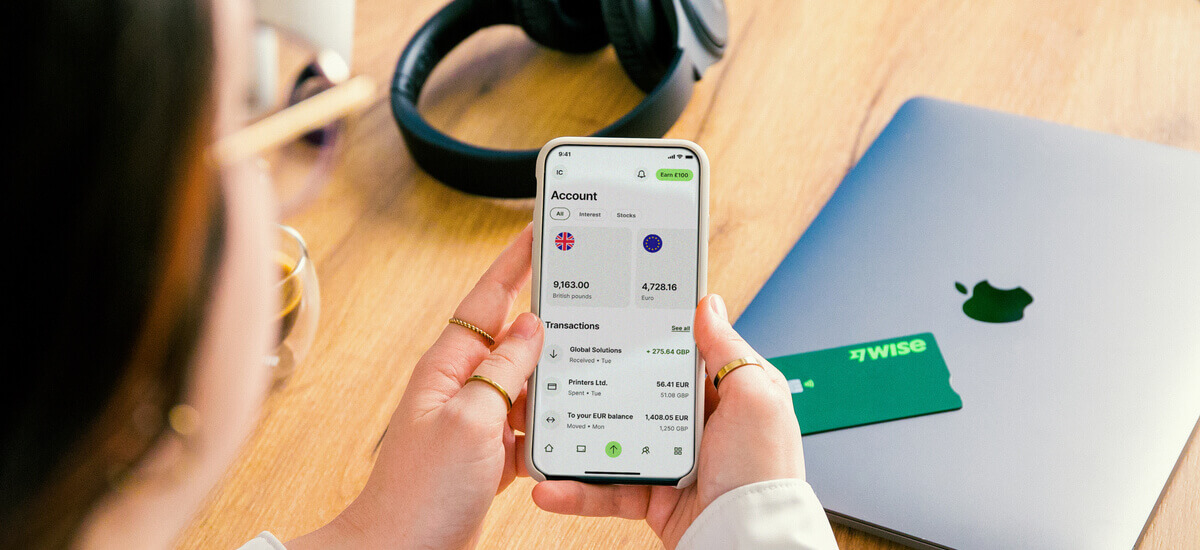
Alongside your payment gateway, Wise Business lets you receive payments with local account details in 8+ currencies, hold balances in 40+ currencies, and pay suppliers directly without forced conversions.
And with ecommerce payments coming to Wise Business soon, the checkout side will be covered in the same place too.
With Wise Business, you can:
Make the wise choice when selecting a business account for all your domestic and global needs.
Be Smart, Get Wise.
*Disclaimer: The UK Wise Business pricing structure is changing with effect from 26/11/2025 date. Receiving money, direct debits and getting paid features are not available with the Essential Plan which you can open for free. Pay a one-time set up fee of £50 to unlock Advanced features including account details to receive payments in 22+ currencies or 8+ currencies for non-swift payments. You’ll also get access to our invoice generating tool, payment links, QuickPay QR codes and the ability to set up direct debits all within one account. Please check our website for the latest pricing information.
Many payment gateways advertise multi-currency support because they can display prices or accept card payments from international customers. But accepting a payment in USD is not the same as settling it in USD.
If the gateway still converts everything to GBP before the money reaches you, you may not be getting the benefit of a true multi-currency setup.
A genuine multi-currency setup (gateway + account) allows funds to be settled and held in the received currency and holds them in a dedicated balance for that currency.
Providers that don't do this will often bury the conversion in the terms rather than the headline, so the fee only becomes visible when you're reconciling at the end of the month.
It depends on lots of factors, such as the volume you’re transacting, where the transaction is taking place, and more. Different providers charge different fees and have different pricing structures.
What matters as much as the transaction fee, though, is whether the gateway settles in the received currency.
A gateway that charges slightly more per transaction but avoids forced conversion will often cost you less overall than a cheaper one that converts everything to GBP on arrival.
Yes, and quite a few UK businesses already do this.
Wise Business is not a payment gateway, so it won't replace your checkout or process card transactions for now. However, ecommerce payments are coming to Wise Business soon, which will change that.
For now, your gateway handles checkout and processing. Wise Business works alongside it as the account where you receive and hold those funds.
You can keep money in the original currency, convert at the mid-market rate when it suits you, and pay suppliers directly from your balance in their local currency.
Yes. Your payment gateway handles the processing side, so a US customer paying in dollars does not require you to have a US account. The funds settle into your currency balance from the UK.
Where local account details do become useful is on the receiving side. Having a US routing number or a European IBAN means customers and platforms pay you like a local business, making the process easier.
💡 Wise Business gives you local account details in currencies.
The simplest way is to stop the conversion happening automatically in the first place. When a gateway converts foreign currency to GBP on arrival, you pay whatever rate it applies, often without much visibility into what that actually costs you.
A gateway that settles in the received currency, paired with Wise Business that converts at the mid-market rate, can put you back in control of both the timing and the cost.
A payment gateway is the technology that processes the transaction at checkout. A merchant account is where the funds land after settlement. Think of the gateway as the till and the merchant account as the drawer the money goes into.
For multi-currency to work properly, you need both handling their side without converting, and it's worth confirming upfront whether a provider bundles them together or sells them separately.
For Shopify, the built-in option is Shopify Payments, which requires no separate setup and keeps everything inside one dashboard. UK fees start at around 2% + £0.25 per online sale depending on your plan6.
Sources:
Sources last checked on 30th March 2026
*Please see terms of use and product availability for your region or visit Wise fees and pricing for the most up to date pricing and fee information.
This publication is provided for general information purposes and does not constitute legal, tax or other professional advice from Wise Payments Limited or its subsidiaries and its affiliates, and it is not intended as a substitute for obtaining advice from a financial advisor or any other professional.
We make no representations, warranties or guarantees, whether expressed or implied, that the content in the publication is accurate, complete or up to date.

Learn how marketplace payment processing works for UK businesses. Our guide explains associated fees, how to optimise payouts, and more.

Learn how to improve your payment authorisation rate and reduce declined transactions. Our guide explains key factors and optimisation strategies to consider.

Learn how pre-authorisation payments work and how they affect business operations. Our guide explains holds, timings, managing customer expectations, and more.

Learn how to reduce chargebacks as an ecommerce business. Our guide offers practical steps covering the various aspects of chargeback prevention.

Learn how 3D Secure (3DS) authentication works for online payments. Our guide explains the process and how to balance fraud prevention with conversion rates.

Learn about some of the best restaurant POS systems for UK businesses. Our guid explains features, fees, use cases, and more.











