
LLCs for Non-US Residents (Complete Guide)
Learn how UK residents can form and manage a US LLC remotely. Our guide covers state costs, tax, banking, compliance and Wise Business payment support tips.



Some of the most successful startups of the past ten years, including Klarna, Synthesia and Mistral AI, have come out of the European tech ecosystem. However, as these companies mature and expand, they often face a significant challenge — they ‘outgrow’ the continent’s capital market.
Typically, this turning point requires them to seek investment from overseas to maintain their momentum and unsurprisingly, most startups will look stateside to the US.
Many European VCs want a share of the later-stage capital market, but remaining competitive against US venture capital behemoths is no easy feat. At two recent Wise Business events, experts across the technology industry shed light on why scaling can be so challenging within Europe, how startups and investors can adapt and what Europe can do to keep up momentum in 2026 and beyond.
Let’s break it down.
It’s no secret that US investors pour significantly more money into startups than their European counterparts. In 2024, American VCs invested $209 billion into startups, while European VCs invested $52 billion — less than a quarter of the US figure.
Simultaneously, US investors are investing in more overseas talent. In 2023, US investors participated in 3,418 rounds outside of their home market, worth $50.2 billion. Some of this may have been helped by the proliferation of remote work and platforms like Zoom, which make it easy for VCs to connect with founders from anywhere in the world.
Some US investors are even setting up shop in Europe. Sequoia Capital, for instance, is expanding their hiring across Europe as they look to invest in more regional talent.
At Sifted Summit, Mike Turner, Partner at Latham & Watkins, summed this up, saying
"Great investors are looking for great founders, period.” This means plenty of capital opportunities for startups based outside Silicon Valley.
Still, as Christine Hockley, Managing Director and Co-Head of Funds at British Business Bank pointed out, "British Business Bank research shows that a business starting up in the US gets 1.9x more capital and that scales as the business grows, up to 2.6x."
But why is that? For one, some founders choose to partner with US investors. Gautier Cloix, CEO at H Company said this was the case for his startup, “it took us three weeks to sign in the US compared to 18 months in Europe.”
While EU VCs may have the capital, they’ve historically approached investment with a different mindset. Martin Ott, CEO at Taxfix says "There is a fundamental difference in attitude" between investors in the two regions. Petr Kozyakov, CEO at Mercuryo said that in the US, the "Risk appetite is much, much bigger."
For many startup founders, this willingness to invest quickly is enticing — it enables them to action their plans more efficiently, rather than waiting months to close a funding round while competitors race ahead.
At Sifted Summit, Bindi Karia, EIC Ambassador and Venture Partner at NED pointed out that "In Europe, we're amazing at starting up and are getting there on scaling up." A big part of that is a lack of late stage funding options.
Sebastian Becker, General Partner at Redalpine echoed this, saying that in Europe, “The top 1% will get funding but you can't build an innovation economy by only funding the 1%.” Like many speakers at Sifted, Sebastian believes that a general cautiousness among European investors puts the region at a disadvantage against its US counterparts, particularly in a technology industry that rewards those that take risks.
From an investor perspective, it’s difficult for European angels and VCs to compete at the Series C, Series D level. For one, the rounds grow bigger — with the average Series C round reaching $58.2 million in Q1 2024 — making it difficult for firms with less funds to participate.
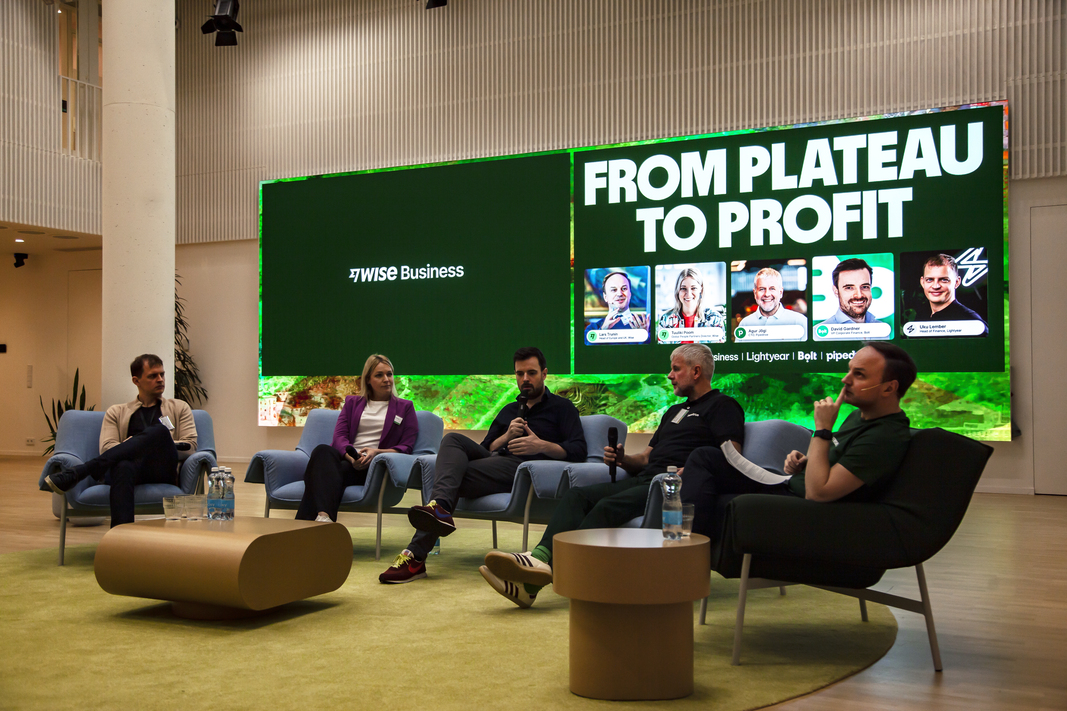
At our ‘From Plateau to Profit’ event for Estonia-based scaleups, David Gardner, VP Corporate Finance at Bolt acknowledged that partnering with investors that can participate in later rounds can help startups scale and for many founders, these investors are American. He says:
“In an ideal world, you're looking for someone who's got long-term capital because it reduces the pressure on an exit. You look for someone who's not maxing out their position size day one, because that then means there's someone you can tap for follow-ons or secondaries.” However, “not everyone will have the luxury of picking an investor.” and at the end of the day, “capital is the priority. Who it comes from is secondary”.
This has lasting implications for European tech. As Anne Germain, Senior Investment Director at BPI France noted, "If your investors are based outside of Europe, it's inevitable that your priorities will shift." In other words, a European startup that works with American investors will inevitably be encouraged to consider growth in their investors’ market, especially if it remains the largest consumer market in the world.
While a disparity exists between the US and European capital markets, European investment is on the rise.
In 2025, investment in growth stage startups (Series B and C) increased by 4.7%year-over-year, while late-stage investment (Series D to pre-IPO) rose an impressive 12.8%.This increase meant that late-stage startups secured 19.6% of all capital invested in the region.
This shift suggests that European VCs are starting to combat the risk adverse behavior that’s held them back by focusing on best-in-class startups, placing larger but fewer bets on companies they think will be the most viable at scale. Though US investors have more money, they aren’t always as successful as their European competitors. Perhaps as a result of their high standards for investment, European VCs have recorded stronger returns than North American VCs over both 10 and 15 year analyses.

At Sifted Summit, Luciana Lixandru, Partner at Sequoia Capital pointed out that “VC is very fragmented in the EU, there are too many VC capitals and it's held us back.” Unlike the US, Europe has no ‘Silicon Valley’ — one urban area that has a majority concentration of the region’s investors and founders. In recent years, Luciana noted that there’s been some consolidation around London, particularly in the AI sector, which has helped the region thrive.
Even amid Europe’s capital fragmentation, all 8 of Europe’s tech hubs recorded funding growth in 2025 — a promising trend for the region’s startups in 2026.
With more investment, it’s now up to founders and their teams to lead the way. Eric Schmidt, Former CEO and Chairman at Google noted that European startups had a tendency to sell early, “European startups shouldn't sell for $100 million.” Instead, he suggested they stay the course and scale until their company reaches $10 billion before exiting. This patience could prove particularly challenging in the AI age however, as big tech companies buy up smaller startups at a fast pace.
Still, European startups have options. Investment and exit opportunities are on the rise and founders in the region continue to make strides in innovation across industries. As we settle into the new year, time will tell how startups and their investors approach scaling up in 2026. But one thing’s for sure — there’s no shortage of momentum in the region.
Learn more about Wise Business
*Please see terms of use and product availability for your region or visit Wise fees and pricing for the most up to date pricing and fee information.
This publication is provided for general information purposes and does not constitute legal, tax or other professional advice from Wise Payments Limited or its subsidiaries and its affiliates, and it is not intended as a substitute for obtaining advice from a financial advisor or any other professional.
We make no representations, warranties or guarantees, whether expressed or implied, that the content in the publication is accurate, complete or up to date.

Learn how UK residents can form and manage a US LLC remotely. Our guide covers state costs, tax, banking, compliance and Wise Business payment support tips.

Hungary's startup ecosystem is on the rise but for many founders, the domestic venture capital market isn't keeping pace. Increasingly, Hungarian founders are...

A comprehensive guide to employee relocation, including how relocation packages work, UK costs, tax considerations and best practices for staff support.

Learn how to structure and manage relocation packages, including costs, policies, implementation steps and global considerations for employers in the UK.

In today’s economy, there’s one thing business owners can be certain of: uncertainty. Volatility has fundamentally changed the way businesses operate. And...

Compare Revolut GlobalHire and Papaya Global across features, pricing and payroll capabilities to find the right solution for your business.











