
Best Business Accounts for Freelancers in Spain
Learn about the best business accounts for freelancers in Spain. Our guide covers features and fees of each provider to help you make an informed decision.


Managing employee spending can be complex, especially when relying on manual processes like receipts and expense sheets. Are corporate credit cards the most effective way for UK businesses to stay in control of company spending?
In this guide, we've broken down how corporate credit cards work, how they compare to small business cards, the types available, key UK providers, and alternative solutions to help streamline expense management.
We've also explained how Wise Business can support businesses with managing employee spending through flexible expense card solutions.
*Disclaimer: The UK Wise Business pricing structure is changing with effect from 26/11/2025 date. Receiving money, direct debits and getting paid features are not available with the Essential Plan which you can open for free. Pay a one-time set up fee of £50 to unlock Advanced features including account details to receive payments in 22+ currencies or 8+ currencies for non-swift payments. You’ll also get access to our invoice generating tool, payment links, QuickPay QR codes and the ability to set up direct debits all within one account. Please check our website for the latest pricing information.

| Topic | Summary |
|---|---|
| Corporate credit cards | Designed for larger businesses to manage employee spending |
| Liability types | Can be individual or corporate, affecting who repays the balance |
| Features | Often include spending controls and expense tracking tools |
| UK providers | Include American Express, Capital On Tap, Metro Bank, and Barclaycard |
| Alternatives | Expense cards, prepaid cards, and debit cards may suit different needs |
Corporate credit cards are a type of credit card given to employees by business owners to incur business-related expenses. They are typically designed for larger organisations to manage business expenses in an efficient way.
Banks and other issuers provide them to the business entity, not the employees. They are generally issued to corporations with established creditworthiness1. However, small businesses with solid revenue streams may also be eligible depending on the provider2.
The basic difference between small business and corporate credit cards is which party is responsible for payments, fees, and other charges. In a corporation, it is the company that bears the liability, whereas small business credit cards often require a personal guarantee from the business owner, meaning they may be personally liable2.
| Corporate credit card | Small business credit card |
|---|---|
| Ideal for bigger companies | Ideal for sole traders or small businesses |
| Typically requires strong business financials | Often relies on the owner’s personal credit |
| Usually company liability | Often requires personal guarantee |
| Designed for employee spending at scale | Designed for smaller-scale operations |
Corporate credit cards work similarly to small-business credit cards in many aspects. Both cards can be used to make purchases and may offer features such as rewards or cashback, depending on the provider.
However, corporate cards are typically designed for larger organisations and often include features like spending controls, reporting tools, and expense tracking2.
Many corporate cards are structured as charge cards, meaning the balance must be paid in full each billing cycle3.
They may also allow companies to track employee expenditure, set spending limits, and monitor transactions3.

There are two main types of corporate credit cards: individual liability and corporate liability.
With individual liability cards, employees are responsible for paying the bill and then seeking reimbursement.
This model allows businesses to issue cards while keeping financial responsibility with the employee, although it may increase administrative work due to reimbursement processes.
With corporate liability cards, the company is responsible for repayment.
This allows businesses to:
Corporate cards can also be structured with full corporate liability or shared liability, depending on the provider3.
Corporate credit cards in the UK often involve detailed applications, with providers reviewing company revenue, structure, and financial profile4.
Here are some key providers:
Fees and features may vary and should be checked on the provider’s website before applying.
The process for requesting a business or corporate credit card can vary depending on the provider.
Some providers may require:
For example, providers currently require details such as company revenue, ownership structure, and financial history as part of the application process4.
Corporate card applications may also involve speaking to a specialist or applying via phone rather than fully online3.
Using corporate cards effectively typically requires clear processes.
Best practices include:
Without appropriate controls, businesses may face risks such as mismanagement or fraud.
A business credit card policy defines how cards can be used and helps ensure compliance.
For tax purposes, HMRC currently requires employers to report taxable expenses or benefits provided to employees9. This includes reporting and paying any associated tax and National Insurance where applicable.
This publication is provided for general information purposes and does not constitute legal, tax or other professional advice from Wise Payments Limited, its subsidiaries or affiliates. It should not be treated as advice from, or a communication with, HMRC, and it is not intended as a substitute for obtaining business advice from a tax advisor or any other professional.
Alternatives include:
These may suit businesses that prefer not to use credit.
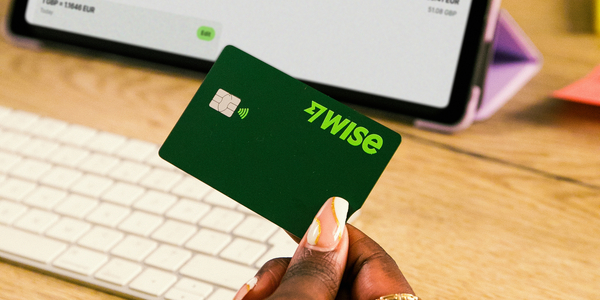
Wise Business Expense Cards (available on the Advanced plan) are designed for tracking employee expenses and managing spending.
They allow businesses to:

Unlike traditional corporate credit cards, Wise Business expense cards are debit-based, meaning spending comes directly from your business account rather than a credit line. This can help businesses avoid debt accumulation while maintaining control over cash flow.
You can also:
Wise Business expense cards also integrate with accounting tools like Xero and QuickBooks, helping automate reconciliation and reduce manual admin. Employees can also upload receipts directly after making purchases, simplifying bookkeeping workflows.
And because the cards are linked to a multi-currency account, businesses can:
Additional features include:
*Disclaimer: The UK Wise Business pricing structure is changing with effect from 26/11/2025 date. Receiving money, direct debits and getting paid features are not available with the Essential Plan which you can open for free. Pay a one-time set up fee of £50 to unlock Advanced features including account details to receive payments in 22+ currencies or 8+ currencies for non-swift payments. You’ll also get access to our invoice generating tool, payment links, QuickPay QR codes and the ability to set up direct debits all within one account. Please check our website for the latest pricing information.

Managing employee expenses across teams and borders can become complex without the right tools.
Wise Business gives you the ability to issue employee cards, set spending limits, and track transactions from one place.
With Wise Business, you can:
Make the wise choice when selecting a business account for all your domestic and global needs.
Be Smart, Get Wise.
Register for Wise Business ✍️
*Disclaimer: The UK Wise Business pricing structure is changing with effect from 26/11/2025 date. Receiving money, direct debits and getting paid features are not available with the Essential Plan which you can open for free. Pay a one-time set up fee of £50 to unlock Advanced features including account details to receive payments in 22+ currencies or 8+ currencies for non-swift payments. You’ll also get access to our invoice generating tool, payment links, QuickPay QR codes and the ability to set up direct debits all within one account. Please check our website for the latest pricing information.
Sources:
Sources last checked on 24 April 2026
*Please see terms of use and product availability for your region or visit Wise fees and pricing for the most up to date pricing and fee information.
This publication is provided for general information purposes and does not constitute legal, tax or other professional advice from Wise Payments Limited or its subsidiaries and its affiliates, and it is not intended as a substitute for obtaining advice from a financial advisor or any other professional.
We make no representations, warranties or guarantees, whether expressed or implied, that the content in the publication is accurate, complete or up to date.

Learn about the best business accounts for freelancers in Spain. Our guide covers features and fees of each provider to help you make an informed decision.

Learn about the best business accounts for freelancers in Italy. Our guide covers features and fees of each provider to help you make an informed decision.

Learn what Revolut GlobalHire is, how it works, and what businesses should consider before using it for global hiring and payroll.
Explore alternatives to Revolut GlobalHire and learn how different solutions compare for managing global payroll and payments.

Understand how Revolut GlobalHire pricing works, the fees involved, and what businesses should expect when managing global payroll across multiple countries.

Learn how to structure payroll payments for remote teams, manage global payroll challenges, and improve payment efficiency across borders.











