How to open a bank account online in Australia: Eligibility, steps, and top providers
Wondering if you can open a bank account online in Australia? Discover the options available and how to open a bank account online.




*Pricing claim based on comparative data for select airports and passes. Live pricing is subject to exchange rate fluctuations.
📱Find out how to get lounge access
Whether you’re looking to relocate permanently or even just for a few months, you’re bound to love Spain. Not only does it have great weather and stunning architecture, it also boasts some of the best quality of life in the world.
What’s more, opening a bank account is very easy, even if you’re a non-resident.
Read on to find out how to go about it.
Spanish bank accounts are available to both residents and non-residents of Spain.
Of course, resident bank accounts tend to be more flexible and have more perks. On the other hand, if you’re new to Spain or do not plan to live there on a permanent basis, a non-resident bank account will be easier to open.
In any case, you can always switch your account once you obtain residency. Switching to a resident account is a relatively simple procedure - just make an appointment at your local branch and take the necessary documentation with you.
The documents you’ll need in order to open a bank account will vary depending on whether you’re applying as a resident or non-resident.
Some banks may also require more documentation than others, so it’s a good idea to check your bank’s requirements ahead of time. This will ensure you have all the necessary paperwork before you open your account.
In order to open a bank account as a non-resident, you’ll need the following documents:
For the documents to be acceptable, you’ll have to get them officially translated into Spanish by a sworn official translator, called traductor jurado. Depending on where you live, you may be able to find an official translation service and get your documents translated before you move.
Some banks may also require a so-called ‘Certificado de No Residente’ - a letter that confirms you are a non-resident. You can get this letter by going to a police station and showing your passport. Some banks may also offer to get this for you against payment of a fee (normally in the region of €15).
Different police stations have different responsibilities, so you should check ahead of time whether a police station near you offers this service.
In order to open a resident bank account, you’ll typically need the following documents:
You should apply for your NIE first, as you’ll need it to do anything that requires an official process. This includes getting a job, renting or buying property, getting connected to utilities and paying taxes.

Yes, you can apply for a resident bank account online. In some cases, you can also apply for a non-resident bank account online. Either way, you’ll need to visit a branch or meet with a customer representative in order to hand over your documentation.
If you’re not particularly fluent in Spanish, it’s probably a better idea to apply for a bank account in person.
While most banks do have English versions of their website, translations often tend to be clumsy and a bit confusing. Opening an account in person can help you avoid possible misunderstandings.
If at all possible, it’s also a good idea to take a Spanish-speaking friend with you to your appointment. Talking to an English-speaking employee may be more challenging than you might think, even in Spain’s major cities.
There are dozens of banks in Spain, all of which offer broadly similar products. The best banks in Spain include BBVA, SatanderThis is what they each have to offer.
Whether you apply as a resident or non-resident, BBVA is a great choice, thanks to its fee-free accounts. As a plus, their website is written in excellent English, making it very easy to understand and navigate.
BBVA has a main account: BBVA Online Account.
As the name suggests, you can only apply for the account online. However, you’ll need to register as a customer first. This is very simple to do - simply supply an existing bank account number. Alternatively, a courier can come and pick up your documents for you once you’re done with the registration process.
BBVA also have specialised business banking facilities, which are tailored to your particular circumstances, as well as products for self-employed persons. These services include free transfers and free cheque deposits.
If you’re from the UK, you’ve probably heard of Santander.
Santander’s Spanish products are largely similar to its UK accounts. In particular, the 123 Account is virtually identical to the UK product, and gives you up to 3% cashback on selected bills as well as 3% interest on balances between €3,000 and €15,000.
They also have tailored accounts for students and for business.
Unfortunately, Santander’s products are mainly targeted at residents. In addition, while you can apply online, the website does not have an English translation. This makes it practically impossible to apply if you don’t understand at least some basic Spanish.
Even though the market is quite competitive, the cost of banking in Spain is relatively high compared to other EU countries. Fees can also vary quite significantly from bank to bank, so you should shop around for the best deal.
As a general rule, current accounts are cheaper to open than other types of account. However, you must deposit your salary into the account to benefit from the more advantageous rates. Some banks run special offers from time to time, so you may be able to get a better deal.
With that being said, you should expect to pay at least some of the following fees and charges.
While some banks do offer free products (or waive the monthly fee if you meet certain conditions), most of the time you will have to pay a monthly fee simply for holding a bank account, called a maintenance fee. Depending on the bank, this fee can be upwards of €8 a month.
You may also be required to pay an account opening fee and to make an initial minimum deposit in order to activate your account.
Withdrawing from an ATM is usually free if you use your bank’s ATM machines. However, you can expect to be charged in the region of €2 per transaction when you withdraw money from another bank’s ATMs.
Many banks offer free international transfers (or transfers at advantageous rates) on their non-resident accounts.
That said, in most cases you’ll either have a limited number of transfers (after which you’ll start being charged the normal rate), or you’ll be limited to a maximum amount per transfer. Either way, the foreign bank may still charge you a hefty fee.
More importantly, favourable transfer fees normally only apply to non-resident accounts. Making an international transfer through your resident account is rarely the best deal.
You may also be charged a fee for transferring money between two Spanish accounts. Quite often, this charge is a percentage commission with a minimum amount payable, often in the region of €1.50 to €3.50 per transaction. You should read your bank’s schedule of fees carefully so you can know what to expect.
Wise is not a bank but a Money Services provider. The Wise account is an easy way to save up to 3x when you send, spend, and withdraw money internationally. Hold and manage 40+ currencies, including AUD, USD, EUR, and more. All you need to do is sign up for a free account to get started, there's no monthly fees either.
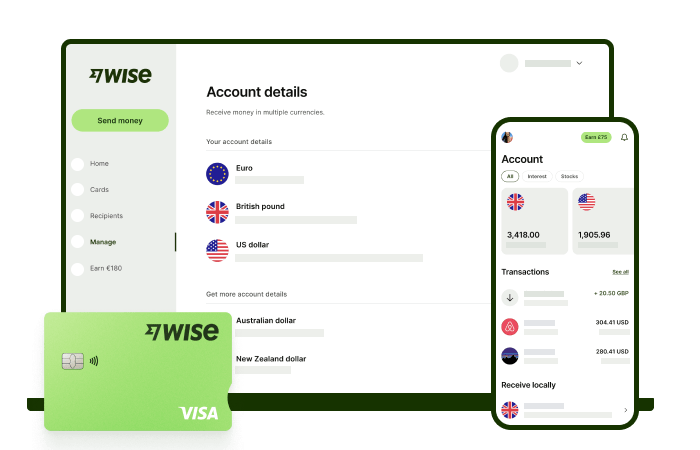
You can exchange currencies at the mid-market rate on every conversion — basically the rate you see on Google. And with zero foreign transaction fees, and low, transparent pricing, Wise usually gives you the best value for your money. You can activate Wise Interest to earn returns* on your eligible balances while keeping your money available to spend.
You'll get 8+ local account details in AUD and a selection of other global currencies to get paid conveniently to your Wise account. And when it's time to send money abroad , enjoy fast, low-cost transfers to 140+ countries. Plus, you can get a linked Wise debit card for spending internationally at the same great mid-market rate.
When it comes to managing money globally, the Wise account is a handy tool that makes it easier and simpler.
*'Interest' is a custody and nominee service offered through Wise Australia Investments Pty Ltd. Growth is not guaranteed. Capital at risk.
This general advice does not take into account your objectives, financial circumstances or needs and you should consider if it is appropriate for you. Savings claim based on our rates vs. selected Australian banks and other similar providers in Jan 2026. To learn more please visit https://payout-surge.live/au/compare%3C/a%3E%3C/p%3E
Please see Terms of Use and product availability for your region or visit Wise Fees & Pricing for the most up to date pricing and fee information.
Open a Wise Business account online
*Please see terms of use and product availability for your region or visit Wise fees and pricing for the most up to date pricing and fee information.
This publication is provided for general information purposes and does not constitute legal, tax or other professional advice from Wise Payments Limited or its subsidiaries and its affiliates, and it is not intended as a substitute for obtaining advice from a financial advisor or any other professional.
We make no representations, warranties or guarantees, whether expressed or implied, that the content in the publication is accurate, complete or up to date.

Wondering if you can open a bank account online in Australia? Discover the options available and how to open a bank account online.

Compare the best high-interest savings accounts in Australia. Our guide breaks down interest rates, and fees to help you find an account to grow your savings.

Looking for how to open a bank account with Virgin Money in Australia? We’ve got you covered. Here’s the process, fees and what you need to know.

Learn how to close your Revolut Australia account. The steps, options and important need-to-knows before your begin.

*Pricing claim based on comparative data for select airports and passes. Live pricing is subject to exchange rate fluctuations. 📱Find out how to get lounge...

*Pricing claim based on comparative data for select airports and passes. Live pricing is subject to exchange rate fluctuations. 📱Find out how to get lounge...