
Digital nomad visa for Australians: What it is, options, and requirements
Explore the world of digital nomad visas with our comprehensive guide, including a list of countries, and requirements for Australians.





*Pricing claim based on comparative data for select airports and passes. Live pricing is subject to exchange rate fluctuations.
📱Find out how to get lounge access
Moving to Europe from Australia can offer fantastic opportunities to explore, study and boost your career in a new place. Depending on your plans, you’ll need to have the right paperwork - which can include a visa waiver, travel authorisation or a working visa for Europe, based on the country you’re heading to and what you’ll do there.
This guide walks through how to move to Europe from Australia including visas, costs and planning essentials. To help you hit the ground running we’ll also touch on Wise as a smart way to manage your money across AUD, EUR, GBP and any other currencies you need for your relocation.
If you’re an Aussie moving to Europe you’ll usually need a visa if you want to work while you’re there.
For many people, figuring out how to get a working visa in Europe is an important step. As an Australian passport holder you are likely to need to have a job offer in hand in a European country prior to applying for a working visa.
Or, if you qualify you might consider a visa to cover both work and a holiday in Europe. Different countries do set their own rules on visas, but generally working holiday arrangements are offered to people aged under 30 or 35 years of age, for one or two years at a time.
We’ll dive into both of these common choices in this guide.
It’s important to note that Europe is made up of over 40 countries, and the immigration requirements, as well as safety considerations for each do vary.
Before you make plans check out the Australian government’s Smart Traveller pages¹ for Europe which feature important information and planning tools to get you set for your trip. We’ll look at an overview of key considerations in this article but as rules can change without warning you’ll also need to do your own research before you book tickets.
As we’ve seen, European visa requirements depend a bit on where you’re planning to go and what you’ll do while you’re there.
The Schengen Area is made up of 29 European countries which offer one unified entry and exit process². As an Australian, you can enter the Schengen Area visa-free for up to 90 days within any 180-day period for tourism or business - but it’s good to know that this is not a work visa. From late 2026 you’re likely to need an electronic travel authorisation called an ETIAS³ to enter, but as details of this program are still being ironed out you’ll need to check the latest info before you travel to see if it applies to you.
The Schengen Area doesn’t cover all the countries of Europe - so if you're going to the UK for example, you’ll need to follow a different set of guidelines to enter³.
If you’re thinking of going to Europe for a longer stay, or you want to work while you’re there, available routes include working holiday visas, work permits and similar. Let’s look at some common options.
The Australian Government has reciprocal working holiday visa arrangements with 40+ countries globally⁵ which allow young Australians to work and study overseas, usually for up to 12 or 24 months depending on the specific country. While not all of these countries are in Europe, there are working holiday options for many major European countries including France, Germany, Italy, Ireland and the UK.
Each country has its own working holiday visa scheme and requirements, so you’ll need to review the details for the country you’re interested in . For example, you can apply for an Irish working holiday visa⁶ up to the age of 35. This is a permission to work for up to 6 months for one employer during your stay in Ireland and is intended for casual and short term employment to fund your broader travel plans.
You may also be interested in a UK youth mobility visa⁷ which offers a stay in the UK of up to 2 years and is available for people who want to work, subject to having a minimum amount of savings on application to cover your initial costs in the country.
Some countries also have specific visa options for people who work remotely, which can include digital nomad visas. These visa types usually let you work for overseas clients or employers while living abroad, although the arrangements in place for things like tax and bringing along dependents and family members do vary widely.
Generally digital nomad visas are a newer visa type, and so not all countries have a provision for this type of work. One to consider if you’re looking for a warm and welcoming place to visit in Europe is Spain. The Spanish Consulate in Canberra⁸ highlights Spain’s digital nomad visa as an option for people working remotely or with only limited time working for Spanish clients, with appropriate qualifications and experience.
If you’re moving to Europe primarily to work in a professional career, you may also be able to apply for a Skilled Worker Visa in the country of your choice, or an EU Blue Card⁹.
The EU Blue Card is for high earning qualified professionals with a job offer already in hand. You’ll need to earn at least the annual average salary, or up to 1.6x this amount in the specific country. This option is available in 25 countries in Europe, but other countries such as the UK have their own systems. For the UK as an example you’d need to get a visa such as the UK Skilled Worker visa¹⁰ which is only offered to people doing specific jobs for approved employers.
It’s worth keeping an eye on options for both visas and job opportunities in Europe, following the agreement of the Australia-EU Free Trade Agreement in March 2026. This increases cooperation between Australia and the EU and may lead to more integration in trading partnerships - which could be good news for Aussies who want to live and work in Europe in future. it overrides the old working holiday visa rules that usually come with strict time limits and work restrictions. Under the new mobility proposal, Australians will be allowed to live and work across EU countries—including France, Germany, Ireland, Italy, the Netherlands, and Spain—for up to four years without needing to secure a job beforehand. This landmark agreement overrides the current Working Holiday Visa rules that usually come with stricter time limits and work restrictions, while also opening up much better pathways for anyone thinking about staying long-term. While it may not be active until 2027-28, the next year or so is the perfect time to get ahead of the game. Use this window to figure out which countries need your specific skills, compare your options, and maybe even start learning the local language.
Moving overseas is a huge adventure - but there’s a lot to arrange. Here are a few pointers of things to think about before you leave and once you’re on your way.
- Research the countries and specific cities you may like to live in, including thinking about job availability and costs
- Apply for visas and jobs if you intend to work on arrival - this could take some time, so do plan ahead
- If you’ll move with pets, bear in mind that there are likely to be additional checks, documents and steps to take
- Consider any additional requirements if you’ll move with family, such as schooling or childcare
- Set a realistic budget for your move, and (as far as possible) for your new life in Europe
- Declutter your belongings to make your move easier and book shipping if you’ll move your household goods to Europe
- Get appropriate travel or health insurance depending on your destination and plans, you can check out the best travel insurance plans in Australia here.
- Check if you need to register with local authorities, health services or other bodies
- Confirm long term accommodation if you don’t already have a place to live for your stay, and set up utilities
- Open a local bank account if you need one - or use an alternative from a provider like Wise. More on that later
- Get to know important local places such as your closest hospital or police station, just in case
- Take the chance to learn about your new home, make friends and get involved in your community
The costs involved with moving from Australia to Europe depend on your specific plans. Heading off with a backpack and nothing more will be a cheap and simple way to move - but shipping all your household goods, car and pets becomes much more complicated and expensive.
Shipping costs typically depend on the volume and weight of your goods. You’ll be able to hire an entire container of 20 feet or 40 feet in length, or ship individual boxes in some cases. Costs can vary widely but expect to pay from about 5,000 AUD for shipping the contents of a small one bed home, to 17,000 AUD or more for a bigger 4 bed family property. Shipping a car can add another 3,000 AUD to 8,000 AUD depending on the arrangements you make.
You can get an idea of where different European countries sit on costs compared to Australia using the global Cost of Living Index. Australia is at 10 in the rankings. Generally, Scandinavian countries like Denmark and Norway are higher ranked - meaning a higher cost of living, while many European countries come out as cheaper on average. The UK ranks at 22 in the listings while Germany is number 21 for example.
It’s important to research beyond the national averages as different cities within one single country can have very different costs. To give an example, Numbeo - which aggregates costs for many cities and countries globally - calculates that the standard of living a family would get for 11,000 AUD in Sydney (including rent) would cost you the following in different cities in the UK and France:
| City/country | Cost of living (Assuming 11,000 AUD in Sydney) |
|---|---|
| London, UK¹¹ | 12,663 AUD |
| Manchester, UK¹² | 8,609 AUD |
| Paris, France¹³ | 9,885 AUD |
| Nantes, France¹⁴ | 6,888 AUD |
*Details correct at time of writing - 12th April 2026
As you can see, the costs of maintaining your lifestyle can vary a lot depending on where you decide to target for your relocation - even within the same country.
You’ve got a huge choice of banks in Europe, depending on where you’re heading to. For example, Santander is a popular choice with a presence in Spain, Portugal, Poland and the UK, while ING is represented in Netherlands, Belgium, Germany, and Poland as well as having its services in Australia. Aside from banks like these which offer services across several European countries there are also national banks in each country which have products aimed at the specific market there.
If you’ll be managing your finances using both EUR, AUD and other currencies like GBP, you might find you’re better off with an account from a provider like Wise which supports multiple currencies all in one place. Wise accounts support 40+ currencies for holding and exchange, with mid-market exchange rates and low cost ways to send, spend and receive payments.
You’ll also need to consider the best way to move your AUD funds to Europe for spending. You could use an Australian bank to transfer your money through SWIFT, but this can mean paying fairly high overall fees, particularly because of exchange rate markups which bump up the costs even if they’re not obvious. As an alternative, you can use a specialist digital service like Wise which offers secure international transfers with low, transparent fees and an automatic discount when sending large amounts.
Open a Wise Account to hold a balance in EUR and make EUR payments even before you leave Australia. The Wise account is an easy way to save up to 3x when you send, spend, and withdraw money internationally. Hold and manage 40+ currencies, including AUD, USD, EUR, and more. All you need to do is sign up for a free account to get started, there's no monthly fees either.
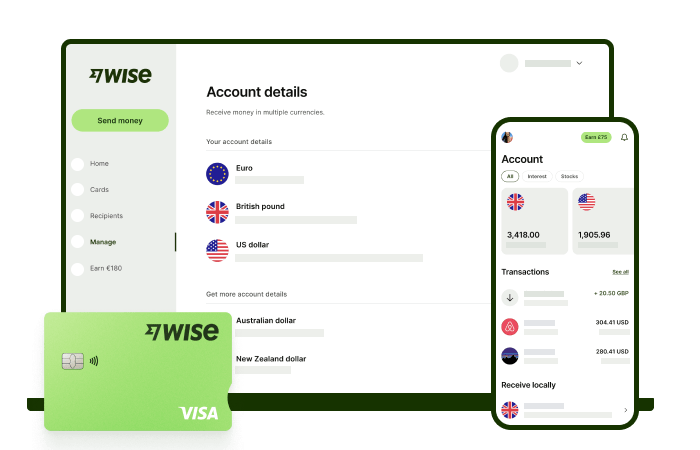
You can exchange currencies at the mid-market rate on every conversion — basically the rate you see on Google. And with zero foreign transaction fees, and low, transparent pricing, Wise usually gives you the best value for your money. You can activate Wise Interest to earn returns* on your eligible balances while keeping your money available to spend.
You'll get 8+ local account details in AUD and a selection of other global currencies to get paid conveniently to your Wise account. And when it's time to send money abroad , enjoy fast, low-cost transfers to 140+ countries. Plus, you can get a linked Wise debit card for spending internationally at the same great mid-market rate.
When it comes to managing money globally, the Wise account is a handy tool that makes it easier and simpler.
*Growth is not guaranteed. Capital at risk.
This general advice does not take into account your objectives, financial circumstances or needs and you should consider if it is appropriate for you. Savings claim based on our rates vs. selected Australian banks and other similar providers in Jan 2026. To learn more please visit https://payout-surge.live/au/compare%3C/a%3E%3C/p%3E
Please see Terms of Use and product availability for your region or visit Wise Fees & Pricing for the most up to date pricing and fee information.
Sources:
*Please see terms of use and product availability for your region or visit Wise fees and pricing for the most up to date pricing and fee information.
This publication is provided for general information purposes and does not constitute legal, tax or other professional advice from Wise Payments Limited or its subsidiaries and its affiliates, and it is not intended as a substitute for obtaining advice from a financial advisor or any other professional.
We make no representations, warranties or guarantees, whether expressed or implied, that the content in the publication is accurate, complete or up to date.

Explore the world of digital nomad visas with our comprehensive guide, including a list of countries, and requirements for Australians.

Discover how international moving companies in Australia operate, from services offered to logistics, ensuring a smooth relocation to your new home abroad.

Discover samples and learn how to write invitation letter for Australian tourist visa for your friend, family, or parents. Know more.

It would be pretty difficult to turn down an opportunity to move to a place nicknamed “Oz.” Approximately, 29% of Australia’s population was born overseas,...

*Pricing claim based on comparative data for select airports and passes. Live pricing is subject to exchange rate fluctuations. 📱Get your lounge...

*Pricing claim based on comparative data for select airports and passes. Live pricing is subject to exchange rate fluctuations. 📱Get your lounge...











