
How to buy FIFA World Cup 26™ tickets: Step-by-step guide
Guide on how to buy world cup tickets 2026: official sales, signup tips & tricks, resale safety, and key dates to secure seats.


| This publication is provided for general information purposes and does not constitute legal, tax or other professional advice from Wise US Inc. or its affiliates, and it is not intended as a substitute for obtaining business advice from a Certified Public Accountant (CPA) or tax lawyer. |
|---|
If you're an American who owns a property in a foreign country, you're likely wondering how to report foreign rental income.
For example, maybe you live overseas full-time and own a house in your new country. Many Americans also still live in the US but own a vacation property abroad that they list on Airbnb when they're not using it.
Regardless of why and how you own foreign real estate, you must report the income it generates to the IRS. You'll likely owe taxes on it, though there are ways to lower your bill.
Here's everything you need to know about reporting foreign rental income, including what you need to report, how to file correctly, and strategies to reduce what you owe.
We'll also introduce the Wise account, which allows you to send, spend, and receive your money across the globe in over 40 currencies – all at the fair mid-market rate.
| Table of contents |
|---|
Yes, US citizens and residents must report all worldwide income to the IRS, including rental income from foreign properties.
This requirement applies whether you live in the US or abroad.
For example, if you live in Bali and collect rent from your property there, that income still must go on your US tax return. The same applies if you live in the US and rent out your vacation property in Mexico.
In both cases, your foreign rental income is reportable and taxable in the US.
You must report all types of foreign rental property income, including:
You must convert all rental income to USD when you report it, using an IRS-approved currency exchange rate that applies to your situation.
The IRS categorizes your foreign property based on how much you personally use it versus how much you rent it out. This classification is important because it determines how you report the income and what expenses you can deduct.
Here are the different criteria:
| Type | Criteria¹ |
|---|---|
| Rental property | You didn't use the property personally during the year, regardless of how many days it was rented |
| Vacation home and rental property | You rented the property for 15+ days AND used it personally for 14 days or less (or less than 10% of rental days) |
| Vacation home and secondary property | You rented the property for 15+ days AND used it personally for 15+ days (or more than 10% of rental days) |
| Not a rental property | You used the property for 15+ days and rented it for fewer than 15 days |
Generally speaking, a rental property gives you the most tax benefits. You can deduct all your rental expenses, even if they exceed your rental income and create a loss.
For a vacation home and rental property, you can deduct rental expenses up to the amount of rental income you earned. Your expenses can't create a loss that reduces your other income.
A vacation home and secondary property classification has tighter restrictions. You need to divide your expenses between personal use and rental use. You can only deduct the rental portion, and only up to your rental income.
If you rented your property for fewer than 15 days, you don't report the rental income. But you also can't deduct any rental expenses.
You need to report foreign rental income on **Schedule E **(Form 1040), which is the same form you'd use for US rental properties. You file this form along with your annual tax return.
The deadline for filing is April 15 if you live in the US. If you live abroad, you automatically get an extension until June 15, with the option to extend further to October 15 if needed.²
Before you fill out Schedule E, you need to convert all your foreign rental income and expenses to USD. To do this, you can use an IRS-approved currency exchange rate.
For annual income, the IRS publishes the average exchange rate for the tax year on its website, so you can get it from there.
For inconsistent or one-time payments (like for an Airbnb), you'll need to use an approved spot rate.
| 💡 Learn more about US taxes on your foreign income in our full guide. |
|---|
You'll most likely have to pay US taxes on your foreign rental income, but luckily, there are ways to reduce your tax bill.
The most common way to offset your foreign income, the Foreign Earned Income Exclusion (FEIE), won't help in this case because it only applies to salaries and wages. Rental income is passive income, so the FEIE doesn't cover it.
But you have other options:
If you have already paid income tax on your rental income to another country, you can use the Foreign Tax Credit to avoid paying tax twice on the same money.
This credit reduces your US tax bill dollar-for-dollar.
For example, let's say you earn 30,000 USD from a rental property in Spain and pay 4,500 USD in Spanish taxes. Your US tax on that income is 6,600 USD. You can subtract the 4,500 USD you already paid, so you only owe 2,100 USD to the IRS.
If you paid more in foreign taxes than you owe in US taxes, you won't get money back, but you can use the extra credit for up to 10 years on future rental income.³
Depreciation means that you can deduct part of your property's value each year for wear and tear. This lowers your taxable income and, as a result, lowers how much you owe to the IRS.
For foreign rental properties, you spread the deduction over 30 years. US properties use 27.5 years, so foreign properties take slightly longer.³
For example, if your property's building is worth 300,000 USD (land doesn't count), you can divide 300,000 USD by 30 years. You get 10,000 USD to deduct every year and reduce your taxable income.
However, when you sell the property later, the IRS may tax this foreign rental property depreciation at 25%.³
You can deduct the costs of running and maintaining your rental property. These expenses reduce your taxable rental income.
| Here are a few examples of deductible expenses: |
|---|
|
Again, you'll need to convert all expenses to USD using an IRS-approved exchange rate, so keep records of everything you spend.

Paying for your US taxes or receiving a tax refund can be tricky — the payment options are often slow and costly, and this doesn’t get better when you’re not in the country and/or manage different currencies.
Whether you’re a US expat, a resident alien, or you have a foreign business, Wise can be an excellent option. With a Wise account, you can either pay your taxes from abroad or receive your tax refund easily. And if you manage more than one currency, you’ll save a lot on exchange rate markups and conversion fees.
When you fill out your tax forms, use your Wise USD Account and routing numbers.
| 🎯 You can find them under “Account Details.” This will let you: |
|---|
|
Wise has no subscription fees or minimum balance requirements, and you can set up an account in minutes.**
You can send, receive, hold, and spend your money in multiple currencies, always with the real exchange rate, and with just a small and transparent fee.*
Get a Wise Account
in minutes 🚀
**Eligibility claim is subject to verification of customer’s identity.
Owning property abroad usually means you have extra reporting requirements in addition to your tax return, such as FBAR and FATCA. These aren't additional taxes. They're information reports. But if you don't file them, you can face hefty penalties.
Plus, if you own your property through a foreign LLC or corporation, you'll have even more forms to file.
Let's take a closer look:
FBAR stands for Foreign Bank Account Report.
You need to file it if the total value of all your foreign bank accounts, including where you keep rental income, goes over 10,000 USD at any point during the year.³
The deadline is April 15, with an automatic extension to October 15.³
Keep in mind that this is something you file separately from your tax return through FinCEN. The IRS isn't involved in this.
| 💡 Learn more about FBAR filing instructions in our full guide. |
|---|
FATCA is the Foreign Account Tax Compliance Act. It covers foreign financial assets like bank accounts, investments, and sometimes your rental property if it's held through certain entities.
You report it on Form 8938 with your tax return.³
You'll need to file FATCA if your foreign assets are over certain thresholds:
| Filing status | Living in the US⁴ | Living abroad⁴ |
|---|---|---|
| Single | 50,000 USD (year-end) or 75,000 USD (anytime) | 200,000 USD (year-end) or 300,000 USD (anytime) |
| Married filing jointly | 100,000 USD (year-end) or 150,000 USD (anytime) | 400,000 USD (year-end) or 600,000 USD (anytime) |
You won't pay any additional taxes, but the IRS may charge you a penalty if you don't file the Form 8938 on time or if you provide inaccurate information.
| 💡 Learn more about FATCA filing requirements in our full guide. |
|---|
Some countries don't let foreigners own property unless they become residents, and to get around this, some Americans buy property through a foreign entity like an LLC, corporation, or trust.
This creates more tax paperwork. Depending on your setup, you might need to file:¹
- Form 5471 for corporations
- Form 8865 for partnerships
- Form 8858 for disregarded entities
- Form 3520-A for trusts
These forms are quite complicated, so usually, the best course of action is to work with a tax professional who's well-versed in this kind of paperwork.
Generally speaking, you'll need to pay tax on overseas property rental income.
You'll report it on Schedule E, converting everything to USD, and then use depreciation and rental expenses to lower your tax bill. If you paid foreign taxes, you can also claim the Foreign Tax Credit.
While you're right to wonder about rental income reporting, many property owners overlook one important cost of owning property abroad: international money transfers.
Often, you'll need to move money between countries. But banks charge high fees and mark up exchange rates, which cuts into your rental income.
Plus, it can be complicated to open and manage accounts in multiple countries in different currencies.
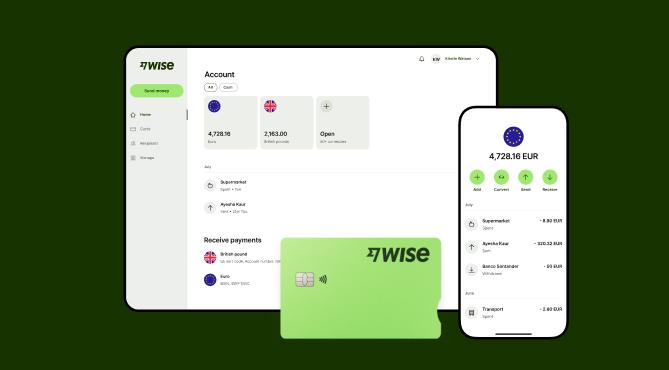
A smart option if you’re sending money overseas: meet Wise.
| With Wise, you can send up to 1,000,000 USD per wire transaction to 140+ countries, with the mid-market exchange rate and low, transparent fees. |
|---|
Over 70% of Wise payments arrive instantly* — and all Wise transfers are deposited directly into your recipient's bank account for convenience.
No ongoing fees, no hidden charges and no hassle — just fast, transparent international transfers that can beat the banks.
🚀Get started with high amount transfers
| See how Wise compares with international bank transfers in our full guide |
|---|
*Transaction speed claimed depends on funds availability, approval by Wise’s proprietary verification system and systems availability of our partners’ banking system, and may not be available for all transactions.
Sources
*Please see terms of use and product availability for your region or visit Wise fees and pricing for the most up to date pricing and fee information.
This publication is provided for general information purposes and does not constitute legal, tax or other professional advice from Wise Payments Limited or its subsidiaries and its affiliates, and it is not intended as a substitute for obtaining advice from a financial advisor or any other professional.
We make no representations, warranties or guarantees, whether expressed or implied, that the content in the publication is accurate, complete or up to date.

Guide on how to buy world cup tickets 2026: official sales, signup tips & tricks, resale safety, and key dates to secure seats.

Interested in Remitly Flex? Find out everything you need to know, including key features, costs, and limits.

Read on for everything you need to know about sending and receiving international wire transfers with Abound.

Receiving a large international wire transfer in the US? Here's a guide on the fees, time, and what you should give to your sender overseas.

Read on for everything you need to know about sending and receiving international transfers with GCash.

Read on for everything you need to know about sending and receiving international wire transfers with Remit2Any.









