
How to Set Up and Use QuickBooks for Nonprofits
Learn to set up QuickBooks for your nonprofit organization. Our step-by-step guide makes accounting simple, so you can concentrate on making an impact



As your company grows, so does the complexity of managing employee spending. Shared cards, manual reviews, and month-end reconciliations can quickly slow down finance teams.
A corporate card with built-in spending controls shifts control to the front end. You set the rules proactively, such as spending limits, merchant restrictions, approval parameters, and monitor spend in real time.
In this guide, we compare three corporate card options available to US companies. We focus on their built-in spending controls, fees, rewards, and how they handle international payments, so you can decide which setup best fits your business. We'll also talk about how the Wise Multi-Currency Card for Business can help your global team operate effectively and control spend.
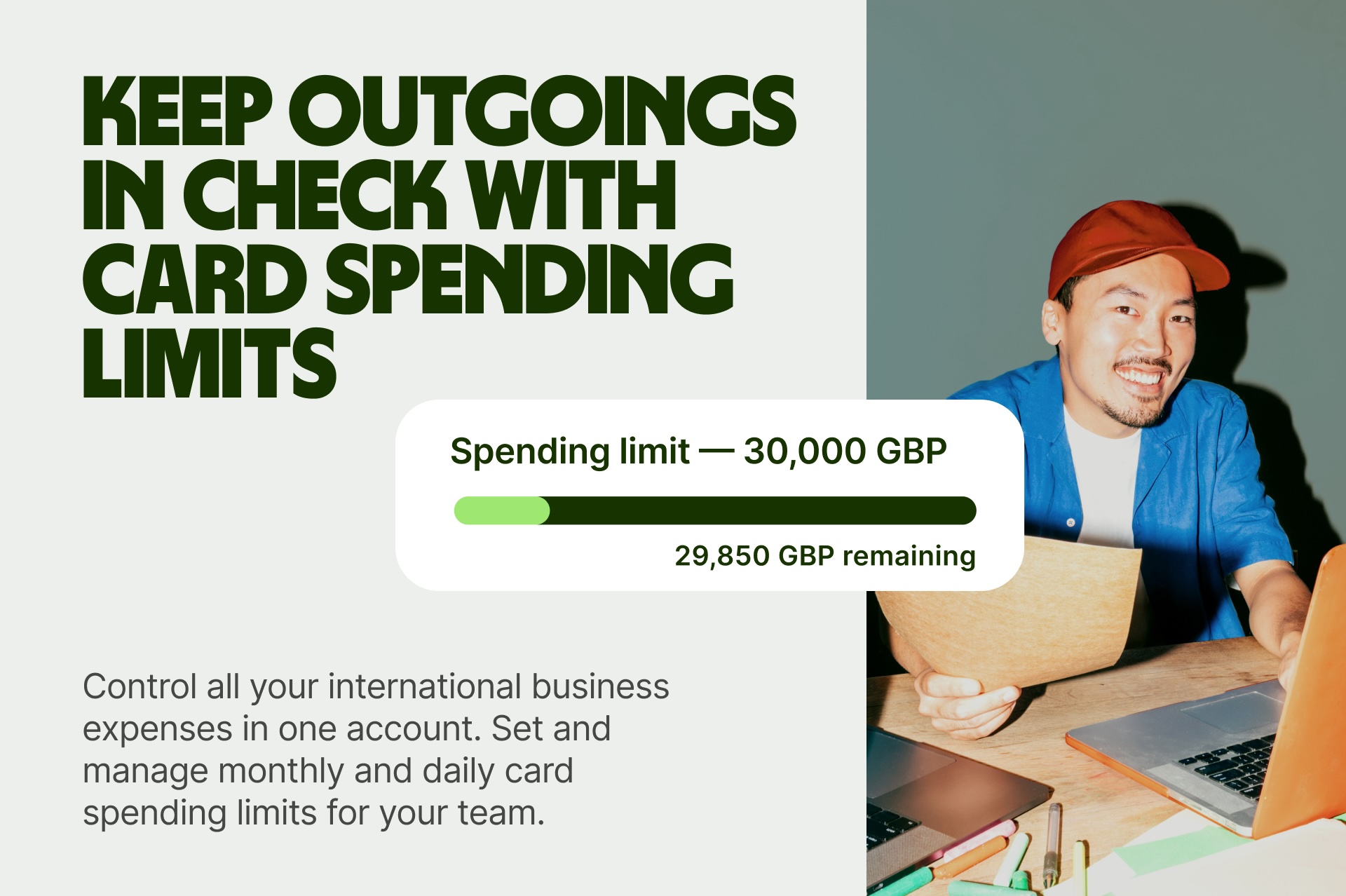

A corporate card with built-in spending controls lets you set rules before money is spent, not after.
Instead of reviewing statements at the end of the month, you define limits upfront. The card then enforces those rules automatically.
Common built-in controls include:
This differs from many traditional business credit cards, where controls are limited, and oversight often happens after the fact. Built-in spending controls reframe expense management as a proactive, not a reactive, activity.
For many businesses, the way money moves has changed.
Spending is no longer centralized within a small finance team. Employees book travel, sign up for software tools, and make purchases from wherever they work. That flexibility improves speed, but it also makes oversight more complex.
Built-in spending controls are one way companies are responding. Here’s why they’re becoming a priority.
When employees are spread across locations, it’s harder to rely on informal oversight. Standardized card limits and automated rules help ensure policies are applied consistently, whether someone is at the office in New York or working remotely.
Software subscriptions often start small but multiply quickly. Virtual cards with dedicated budgets make it easier to track recurring charges, adjust limits, or cancel a single vendor without disrupting others.
Shared cards or broad spending authority can increase exposure. Merchant restrictions and real-time monitoring reduce the likelihood of unauthorized or out-of-policy transactions.
When transactions are visible immediately and categorized automatically, reconciliation becomes simpler. That can shorten the time needed to close the books.
If spending rules are enforced at the point of purchase, there’s less need for follow-up emails, reimbursement corrections, or manual audits.
Seeing committed spending in real time gives leadership a clearer view of outgoing cash, making forecasting and budgeting more reliable.
For growing US companies, spending controls are less about restriction and more about structure. They help balance employee freedom with clearer financial oversight.
If your company is looking for stronger control over employee spending, several corporate card providers now offer built-in policy enforcement and real-time oversight.
Below, we look at three commonly used options in the US. Each approaches spending controls slightly differently, particularly in how rules are applied, eligibility is determined, and international payments are handled.
Automation sits at the core of the Expensify Card. Instead of layering expense software on top of a separate card provider, the two are tightly integrated from the start.¹
Every transaction syncs directly into the Expensify platform, where receipts are automatically captured, categorized, and turned into reports. For finance teams trying to eliminate manual expense reviews, that integration is the main draw.
The Expensify Card is built around the concept of "continuous accounting," where spending controls are tied to real-time smart limits. Admins can set unchangeable daily or monthly limits, but it offers additional functionality in its tiered "Settlement Labels" and merchant-specific rules.
For 2026, they’ve introduced advanced merchant controls that allow you to automate categories, tags, and descriptions for specific vendors, or even require itemized receipts for certain types of purchases (like software vs. meals).⁵
If an employee exceeds a limit or violates a category rule, the card can be set to auto-pause, ensuring that the finance team doesn't have to "chase" receipts after the money is already gone.
When fintech companies expand beyond a single US entity, managing finances gets more complicated. Multiple subsidiaries, international contractors, and cross-border payments require tighter control and better visibility. Jeeves is built with that global structure in mind.²
Rather than acting as just another card issuer, Jeeves positions itself as a broader finance platform. It combines pre-funded corporate cards with embedded spend controls and cross-border payment capabilities.
Jeeves focuses on flexibility for global teams, allowing admins to adjust spending limits instantly across both physical and virtual cards from a single dashboard. Its controls are designed to be "preventative," meaning you can embed specific expense policies directly into the card program to stop unauthorized spend before it happens.⁷
Because Jeeves often operates on a pre-funded model (Jeeves Cash), it provides a hard stop on spending based on the available balance you've allocated to specific entities or roles. This is particularly useful for international companies that need to manage different currencies and local spending caps without the risk of over-extension.
Navan has evolved from a travel booking tool into a fintech platform. It is unique because it owns the entire "travel stack"—from the booking engine to the corporate card and the expense software.³ For US fintech companies that have employees on the road, Navan eliminates the need for manual expense reports.
Because Navan is deeply integrated with travel booking, its controls are uniquely contextual. For instance, a card’s limit can automatically adjust based on the specific travel policy for a flight or hotel booked through the platform. It also features "dynamic policy enforcement," where spending rules automatically update when an employee’s role or department changes in your HRIS, making it one of the most automated options for large, shifting organizations.⁴
Cross-border operations change everything about how a fintech company manages cash. The Wise Multi-Currency Card isn’t a credit card, but for US fintech teams working internationally, it often becomes the backbone of the finance stack.
Built for companies that hold, send, and receive funds in multiple currencies, Wise reduces friction around international payments. That matters when you’re paying overseas contractors, settling SaaS invoices, or collecting revenue from global customers.
Great for: Fintech teams managing international vendors, overseas contractors, or multi-currency revenue streams.
Account advantages: Transparent FX pricing, no hidden exchange rate markups, ability to send and receive payments like a local business in multiple countries.
Wise Business often complements a corporate credit card rather than replacing one.

Not all corporate cards offer the same level of control. Some focus on rewards. Others focus on automation. The right choice depends on how your company manages spending today.
When comparing options, it helps to work through a simple checklist.
Ask yourself:
The strongest solutions prevent out-of-policy spending before it occurs while keeping month-end reconciliation simple.
If your business pays international vendors or remote teams, it’s worth taking a closer look at how your corporate card handles exchange rates.
Certain cards hit you with a foreign transaction fee on every international purchase. Others promise no FX fee but build a margin into the exchange rate instead. In those cases, you’re still paying, just in a less obvious way.
Over time, those percentage differences can add up, especially if you’re paying global contractors, SaaS tools priced in other currencies, or overseas suppliers every month.
Before choosing a card, check both the stated foreign transaction fee and the exchange rate used to convert the payment.
If international payments are a regular part of your operating model, you may also want to compare your card with alternatives designed specifically for cross-border spend. Wise Business uses the mid-market exchange rate with transparent, upfront fees, so you can see exactly what you’re paying before you send a transfer.

Sources:
*Please see terms of use and product availability for your region or visit Wise fees and pricing for the most up to date pricing and fee information.
This publication is provided for general information purposes and does not constitute legal, tax or other professional advice from Wise Payments Limited or its subsidiaries and its affiliates, and it is not intended as a substitute for obtaining advice from a financial advisor or any other professional.
We make no representations, warranties or guarantees, whether expressed or implied, that the content in the publication is accurate, complete or up to date.

Learn to set up QuickBooks for your nonprofit organization. Our step-by-step guide makes accounting simple, so you can concentrate on making an impact

Discover the limits of your PayPal Business Debit Card for purchases, withdrawals, and more. Maximize your business transactions with our helpful guide

Discover the best prepaid business credit cards to help you manage expenses effortlessly. Control your spending and simplify your finances today!

Discover the top banks offering same-day business account openings. Streamline your finances and get started quickly with our expert recommendations

Discover the top 5 free accounting software options for nonprofits! Simplify your finances and focus on your mission with these user-friendly tools.

Discover the key differences between OFX and Airwallex in our detailed comparison of international business accounts. Make informed decisions for your business











