
Cash or card in South Korea: Which is the best way to pay? UK guide
Should you pay with cash or card in South Korea? A handy guide including cash etiquette, South Korean ATMs and using your UK card.



Planning a trip to South Korea? Whether you're heading to the neon-lit streets of Seoul or the bamboo forests of Damyang, there are some logistical details to sort out first.
We’ve got you covered: this guide breaks down the entry and visa requirements for the East Asian country of South Korea.
We'll also introduce the Wise card from the money services provider Wise. This clever debit card automatically converts your pounds to the local currency at the mid-market exchange rate in 150+ countries, only adding a tiny, transparent conversion fee* - or it's free if you already have the local currency in your Wise account.
🔎 Learn more about the Wise card
No. British citizens travelling from the UK can visit South Korea visa-free for up to 90 days for short term tourism.
You’ll need a visa if you plan to work or study — even for a short period of time — or stay longer than 90 days.1
Non-British passport holders travelling from the UK may also need a visa depending on their nationality.
British citizens are exempt through December 2026 from needing a ‘K-ETA’ pass, which allows travel to South Korea (for tourism or business purposes) through the country’s electronic travel authorisation system.2
Instead, you’ll need to fill out an online arrival declaration - called the e-arrival card - up to 72 hours before arrival.3
You'll only need to show a UK passport valid for the duration of your stay in South Korea.
If you enter the country on a long-term visa, your passport will need to have an expiry date six months later than your date of arrival.
You'll also need to keep proof of onward/return travel, as you might be asked to present it at the border.1
If you’re visiting South Korea as a tourist, you’ll only need to fill out an e-arrival card, which is phasing out paper arrival cards at the border.
British citizens are currently exempt from needing a K-ETA. However, you can still opt to fill one out instead of an e-arrival card. It will be valid for three years after it’s approved, meaning it can be used for multiple visits within this time.4
There are several other types of visas available to British citizens who’d like to travel to South Korea for longer than 90 days, or to teach or study.
The following table breaks down the most common types of visas for UK citizens planning for a stay in South Korea.5
| Visa/entry type | Visa code | What it's for | Maximum stay | Key notes |
|---|---|---|---|---|
| Visa-free entry | (visa waiver) | Tourism, visiting friends/family, short-term business | Up to 90 days | Until the end of 2026 UK citizens don't need a E-ETA |
| Short-term employment | C-4 | Temporary or contract-based work (performances, lectures, projects) | Usually up to 90 days | Paid activity allowed only within approved scope; visa-free entry cannot be used for work. |
| Language and non-degree studies | D-4 | Korean language courses, vocational or technical training | Usually 6 to 24 months | Common for language learners; part-time work possible with permission after arrival. |
| Working holiday visa | H-1 | Young UK citizens wanting to holiday and work part-time | Up to 12 months | Available to UK citizens aged approx. 18–30 (sometimes up to 35). Work restrictions apply. |
| Professional work visas | E-1 to E-7 | Teaching, research, engineering, IT, skilled professions | 1–2 years (renewable) | Includes E-2 (English teachers) and E-7 (specialist professionals). |
- UK applicants apply through the Korea Visa Application Center (KVAC) in London
- Applications are started and tracked via the Korea Visa Portal
- Most applications are submitted by post
- Valid passport (usually with at least 6 months’ validity)
- Recent passport photo
- Additional documents depending on visa type (e.g. job offer, university acceptance, proof of funds)
- Payment of visa and service/processing fees
An e-arrival card is completely free of charge. Only third party websites will charge a fee.
A K-ETA costs 10,000 Korean won (KRW), or approximately 5 to 6 GBP. It’s possible to pay this fee by credit or debit card via the official application website.3
The costs for other types of visas will vary widely depending on where you apply, and the duration of your stay. You can check and confirm the up-to-date fees on the Korea Visa Portal.
British citizens don’t need a visa for visiting South Korea for tourism for up to a 90 day period. They are currently exempt from the K-ETA electronic travel authorisation, but will still need to fill out an e-arrival card.
However, if you’re planning on working, studying or staying longer in the country, there are several visa options at your disposal which can easily be applied for in advance of arrival.
Open a Wise account online and you can order the Wise card for a one-time fee of £7. You can use this clever card in 150+ countries. It automatically converts your pounds to local currency whenever you spend using the mid-market exchange rate, only adding a tiny, transparent conversion fee* – or it’s free if you already have the local currency in your Wise account.
You also get two free ATM withdrawals for up to 200 GBP (or currency equivalent) each month. Wise will not charge you for these withdrawals, but some additional charges may occur from independent ATM networks.
If you’re visiting South Korea as a tourist, you’ll need to bring your passport (valid through the duration of your stay), and proof of onward or return travel. A K-ETA travel authorisation for British tourists is currently not required until the end of 2026.7
Travellers are required to submit their K-ETA at least 72 hours before boarding their flight. But to be on the safe side you should apply a week or two before departure to leave room for any unexpected delays or departures.
There are no required vaccinations, but it’s recommended that UK travellers are vaccinated against tetanus and MMR.8
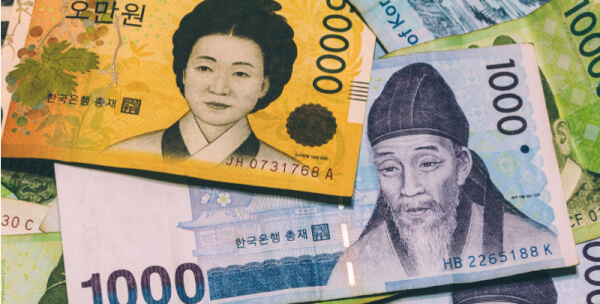
In South Korea, debit and credit cards account for the vast majority of payments, with more people also using digital payment methods.
Sources used for this article:
Sources checked on 11-December-2025
*Please see terms of use and product availability for your region or visit Wise fees and pricing for the most up to date pricing and fee information.
This publication is provided for general information purposes and does not constitute legal, tax or other professional advice from Wise Payments Limited or its subsidiaries and its affiliates, and it is not intended as a substitute for obtaining advice from a financial advisor or any other professional.
We make no representations, warranties or guarantees, whether expressed or implied, that the content in the publication is accurate, complete or up to date.

Should you pay with cash or card in South Korea? A handy guide including cash etiquette, South Korean ATMs and using your UK card.

This article gets you one step closer to your affordable vacation in South Korea by detailing your options for VAT refund in Korea as a tourist.
Modern and fast-paced, South Korea is becoming more and more on the radar for tourists and expats alike. South Korea is the 6th most visited country in Asia,...









