
Q4 2023 Mission Update: Price
Our average price stayed at 0.67% in Q4 2023. Overall, this quarter we 😞Increased fees on sending USD to countries outside the USA when using the SWIFT...



At Wise, our vision is money without borders. In order to build the future of global money, we need a team that’s as diverse as the customers we serve.
In September 2020 we signed the HM Treasury’s Women in Finance Charter, pledging to improve the representation of women in the Wise senior leadership team. The Women in Finance Charter was created to increase women’s representation across financial services, especially in the most senior management levels of their organisations.
This report covers the work we’re doing at Wise to achieve better women’s representation, our UK reporting on the Gender Pay Gap and our progress towards our Women in Finance Charter goal.
Overall, women represent 52% of Wisers and we are pleased to have maintained 46% women among our Leads (managers). Our focus continues to be on increasing our representation of women in our most senior leadership levels (Level 8+ or Director and above) which is currently at 31% (up +7.2 pp since 2020). Our aspirational goal is to reach 35% by the end of 2028 as a milestone goal before aiming to reach 40% beyond that.
We have achieved 40% representation of women at our Executive Committee level (C-suite) with the addition of our Chief Compliance Officer, Nita Patel, and 44% at our Executive Board level demonstrating the continued progress we have made over the last 3 years, particularly at the top of our organisation.
As of today, we are pleased that all our functional teams are made up of more than 40% women globally, with the exception of the Engineering team only.
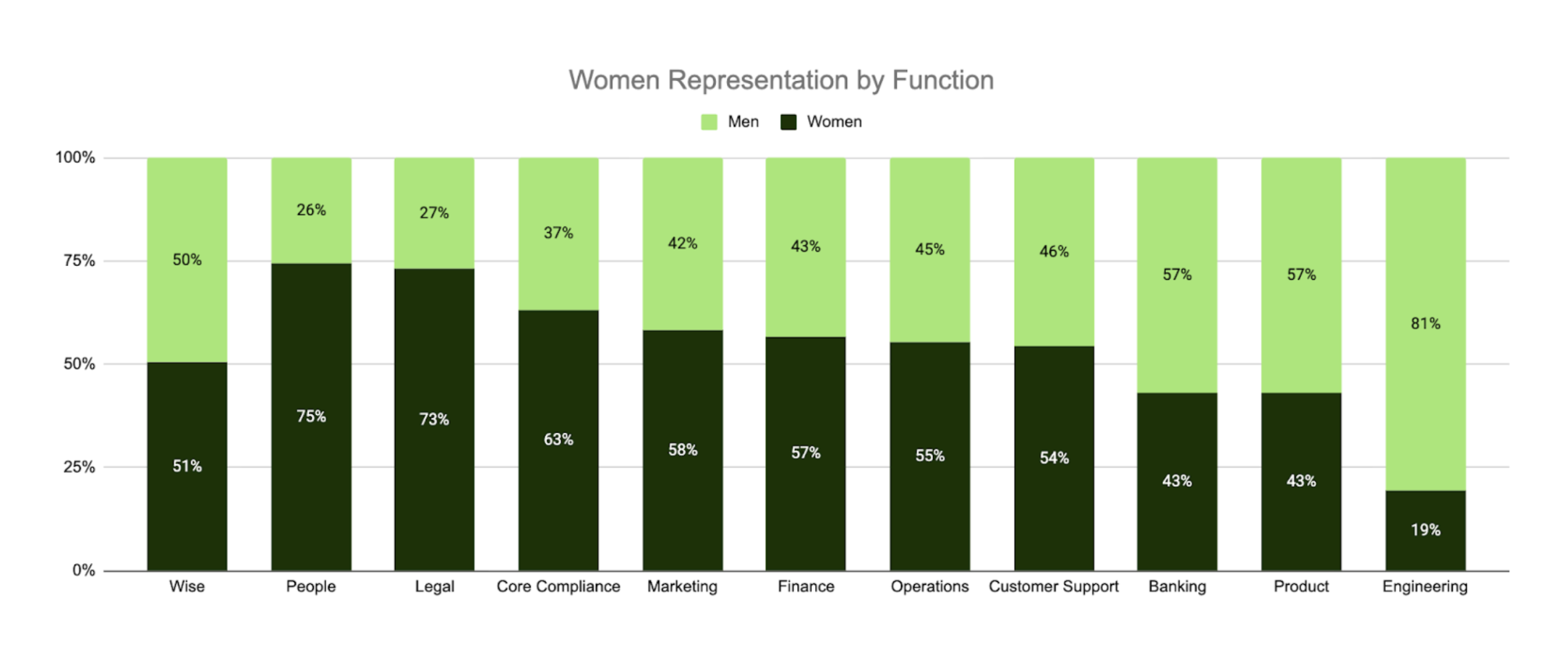
The functional teams that are currently below the 40% Senior leadership aspirational goal have set specific OKRs and action plans dedicated to improving the representation of Senior women leaders at Wise across hiring, retention and career development opportunities.
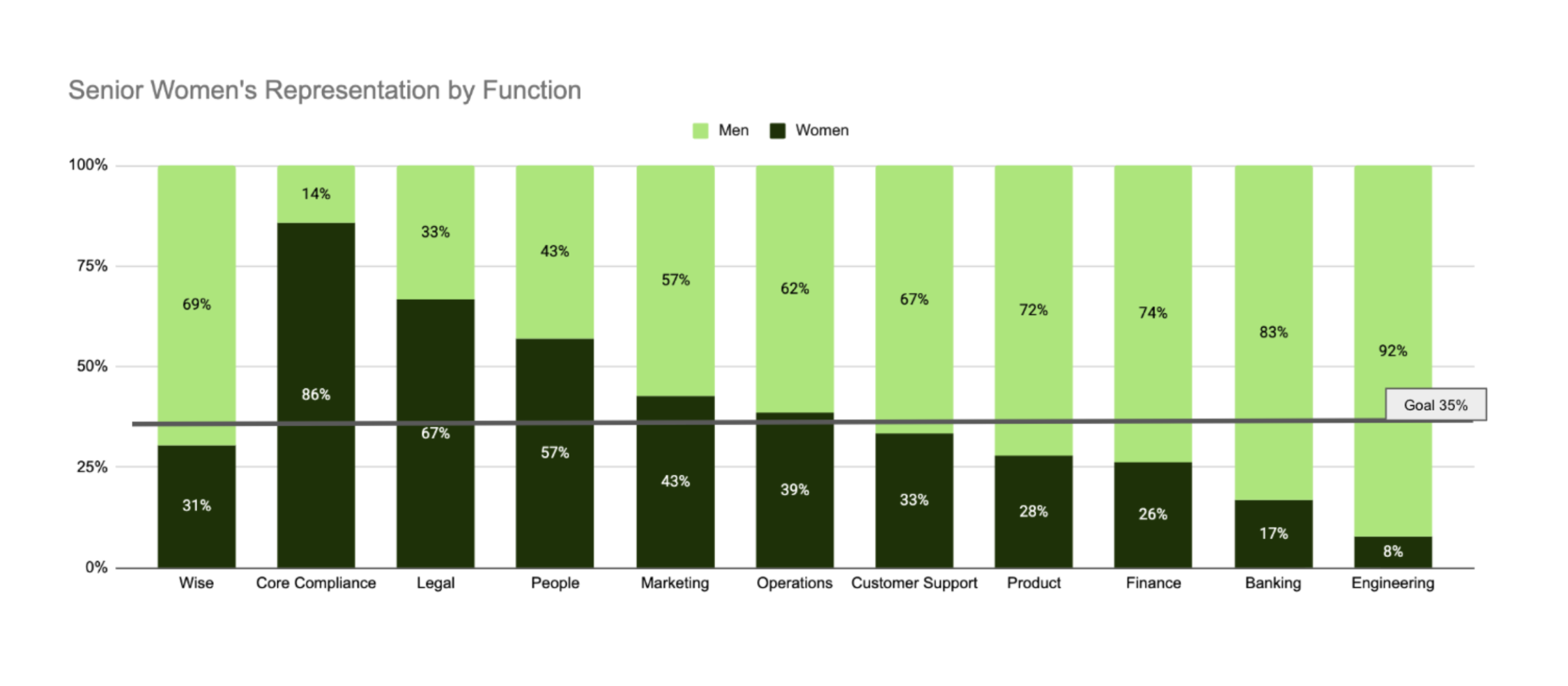
Some of the function specific initiatives include mitigating any potential biases in their people-related processes, more deliberate outreach to senior women candidates and diversity-related recruitment organisations, and ensuring talent management and career growth opportunities for their pipeline of Senior women.
This year we continued to evolve our regular Gender Pay Gap audits and analysis in more granular detail function by function, and by different demographics, in order to inform our analysis and insights before and after salary reviews. We continued to ensure additional deliberate “speed bumps” or check-in moments for reviewing and challenging decisions where necessary around potential gender pay differentials, through Leads (manager) training and communications.
In the last two years, we developed our Women’s representation data reporting and analytics capability to help us understand where we need to continue to focus across hiring, promotions, and retention levers across each function at a more granular level. This has helped us better understand the root causes of any gaps or challenges per functional team.
Areas where we’ve seen improvement since last year include:
Our focus for 2026 will be continuing with deliberate actions across specific functional teams, particularly our tech-teams, to ensure more consistency, sustainability and scalability in our approaches; strengthening our internal diverse pipeline of leaders and continuing to broaden our hiring strategies to attract the widest set of talent pools available. Some of these focus areas in 2026 include:
We are focused on developing a diverse early careers pipeline particularly for engineering and tech-related roles. We know we can make a huge difference in increasing access, aspiration and inspiration for those from underrepresented backgrounds in the tech industry, including women.
In FY2025, we continued our WiseWomenCode programme, helping more women and non-binary people enter the tech industry. The programme’s aim is to strengthen the pipeline of women who have the skills to join our intern and graduate programmes. It is 3 days of knowledge sharing, side-by-side coding sessions and networking to provide a glimpse into the fintech industry. We encourage applications from current students, those having recently switched careers and those who return to the workforce after extended leave. This year 62 women and non-binary people participated in 4 events across London, Tallinn, Budapest and Singapore. 3 individuals were offered a graduate or internship role as a result of the FY2025 sessions. To offer even more women a glimpse into the fintech world, we launched a competition in Austin for 2 participants to join our event in London.
We continued to develop our scholarship strategy in FY2025 to promote early-career roles to more underrepresented groups.
Through WiseStart, our early career and career switcher programme, we’ve created more opportunities, including 4 tech-focused scholarships in Estonia and 3 in the UK. Each scholarship recipient was given financial support along with access to networking and mentoring opportunities throughout the 2025/26 academic year. Our scholarship winners were also matched with a dedicated mentor for the academic year and those that were eligible participated in our WiseWomenCode sessions.
This not only provides financial support to our recipients, but offers mentoring and networking opportunities throughout the academic year. With Wise Scholarships, we are encouraging a deeper shift in the tech industry in breaking down financial barriers, particularly for those from low-income backgrounds. In 2025 we awarded 7 students with such scholarships across London, Tallinn and Tartu, and wish to grow this next year.
For the third time running, our employee engagement survey has seen very high sentiment scores for inclusion - coming in the top 5% for inclusion against the benchmark of global technology companies.
Creating safe spaces, peer connectivity and thought leadership is key to driving our inclusive culture forwards. We have 13 Global Wise Communities (Employee Resource Groups) dedicated to fostering a diverse and inclusive workplace including Queerwise (LGBTQIA+), Black Wisers Network and Wise Women to name a few. We also profile a diverse range of Senior women and non-binary Wisers from all communities across many different internal and external speaker events and communications such as Chetna, Head of Operations, Global Product teamand Jessie Apple, Head of Fincrime Compliance & Risk.
Our Wise Women Community and Wise Women in Engineering Communities, which are both open to women, trans and non-binary Wisers, hold regular community events to support career growth, networking and skills development. This year we have implemented a stronger governance structure across all 13 global DEI communities, to ensure better alignment with our DEI objectives, ensure localised approaches to community-building and enable more peer-to-peer connections. For our Wise Women Community this year, we hosted specific wellbeing-related workshops and “Women Circles” (speaker-led networking and peer-to-peer learning sessions) across different locations to support peer-to-peer support.
We are further investing in our Senior women and non-binary external community in particular, including peer networking lunches and hosting tech-specific events such as Women in Product and Lunch & Learns, for both the internal and the wider fintech women’s community.
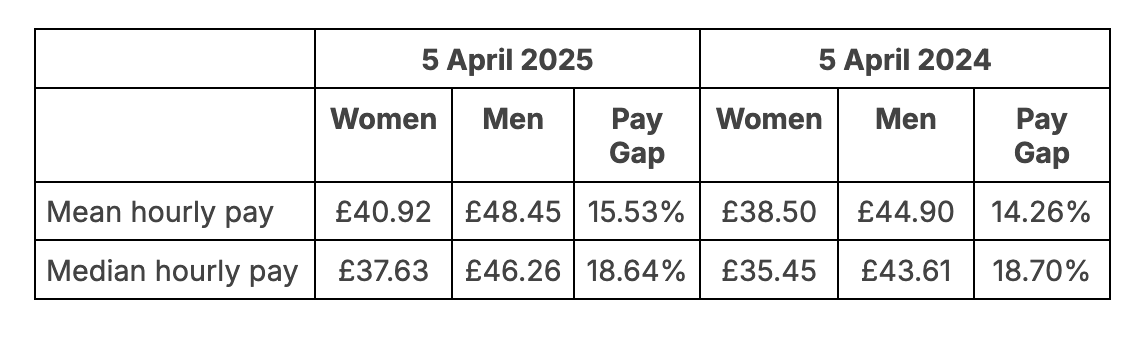
The data below provides our UK Gender Pay Gap as of the 5th April 2025 snapshot date as per the requirements of the Equality Act 2010 (Gender Pay Gap Information) Regulations 2017.
On 5th April 2025, Wise had 1153 people working in the UK, based out of the London office. 39% of the team were women, 61% were men.
We are able to identify the key driver of our Gender Pay Gap, when we split our population into technical teams (Product, Engineering and Analytics) and non-technical teams (Servicing, Operations, Core Functions). Our non-technical teams are relatively evenly balanced at 58% women to 42% men, increasing our number of women compared to last year (55% women to 45% men). However, for our technical teams, there is a higher proportion of men to women at 70% to 30% (a small improvement on last year where the ratio was 71% to 29%). These roles tend to pay higher salaries, thus, continuing to focus on improving our pipeline of women talent in these areas will be key to closing the gap. However the improvement in increasing the number of women at Wise is reflected in the slight dip in our median pay gap (data is consolidated for all roles and levels).
* Data for 2025 is taken as of April 2025 payroll, on the 5th April 2025
* Data for 2024 is taken as of April 2024 payroll, on the 5th April 2024
*To calculate this data, we have used the legal and binary form of gender for team members. We plan to report on the basis of employees’ gender identity once our minimum thresholds for reporting are met.
Our mean hourly pay gap has increased by 1.3 percentage points, however our median hourly pay gap has decreased by almost 0.6 percentage points.
Our mean pay gap increased largely due to significant pay growth among men in our top earnings quartile. This was most pronounced in Banking, Product, and Finance, where market rates for specialist roles have risen sharply. Although salary growth was higher for women, in percentage terms across most of the company, the larger overall value of increases (as based on higher base salaries) awarded to senior men—who still make up the majority of our top quartile—outweighed those gains.
Stock is offered as a key part of our compensation package instead of bonuses. It's a long term incentive and one of the ways employees can benefit from the growth in value of our business. That means all our employees have a share in our mission and a responsibility to make our business a success.
Since listing as a public company in 2021, stock awards are provided as Restricted Stock Units (RSUs) based on pre-determined amounts for each role and level. As part of our commitment to transparency, we share all of our stock levels with our Wisers, which are granted in GBP so we ensure Wisers globally benefit from consistency and locations with large currency changes do not lose out.
For the Gender Pay Gap calculations, we are required to use the value of equity based on when the tax liability arises for the employee. For stock options (NSOs) which Wise offered between 2011 and 2022, this is when options are exercised. It is important to highlight that it’s an employee’s own choice to exercise their stock options, as well as when, and at what price. Therefore, it is based on choices an individual makes, such that the calculations are not reflective of any potential bias in awards, and are dependent on the price at when an employee chooses to exercise their stock options or the value of an RSUs at vesting.
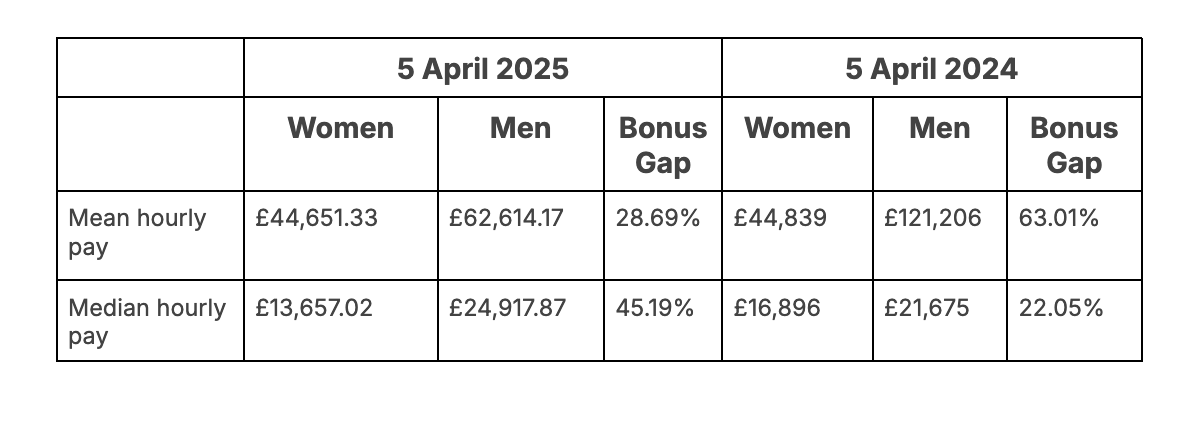
The table below provides the values of the NSOs and RSUs that were exercised in the reporting period reported, as well as all other forms of payment offered at Wise which are classified as bonuses under the UK Gender Pay Gap reporting requirements. These other payments are the employee job referral scheme (approximately £1200), a £1000 payment alongside our six-week paid sabbatical for employees who serve four years at Wise, and relocation allowances.
Whilst the data below fulfils our reporting requirements for the Bonus Gap, we do not believe, as based on the reasons stated above, that this is indicative of any potential inherent biases. We are continuing to monitor pay gaps for men and women alike.
Gender Bonus Gap Calculation (Statutory Reporting)
* Data for 2024 is taken as of April 2025 payroll, on the 5th April 2025
* Data for 2023 is taken as of April 2024 payroll, on the 5th April 2024
As per the UK Gender Pay Reporting requirements, everyone in scope is split into four equal quartiles from the lowest to the highest paid. This year, women’s representation has increased in the top quartile again, and we’ve also noticed bigger increases of women’s representation at the upper middle quartile as well. However some of this is counterbalanced with a 5% increase in representation by women in the lowest quartile, taking the split of men and women from fairly even to closer to a 60:40 split. Overall, the outlook of these numbers is positive as we look to increase our female representation in the top quartiles, which we believe is essential to closing the gender pay gap.

Wise employs over 6,500 people across 11 key locations. Since we last reported in 2023, our UK team, based in the London office, has continued to grow and now exceeds 1,000 employees.
We know that a major factor impacting the gender pay gap is that a significant proportion of our higher paying roles are within tech-related functions across our Engineering and Product teams. Hence our goals focus on increasing the number of Senior women across all functions where we are below 40% representation (Level 8+ or Director and above). We have already seen progress in this area in the last year and remain confident that as these newly promoted women progress through the senior bands, we will see a positive trajectory on our pay gaps. We are also focused on increasing our overall Senior women’s leadership representation across Banking, Engineering, Finance and Product in order to increase our overall internal diverse leadership pipeline at Wise.
The 3 main levers we have to accelerate the pace of change are: hiring, retention and career development.
We’re committed to monitoring and reducing Wise’s gender pay gap and meeting our Women in Finance Charter goal of 35% Senior women leaders by the end of 2028 and aiming for 40% beyond 2028.
Here are a few example initiatives that we’re continuing to deliver in 2025:
1. Widening the recruitment funnel and continuing to source Senior women leaders
2. Enhancing our inclusive decision-making processes and mitigating any potential biases
3. Developing our internal diverse leadership pipeline, including women leaders
This year we have continued to expand our DEI learning opportunities to build on the foundations we established in the last two years. Key DEI learning components are now integrated into both mandatory and on-demand training programmes for Leads and we have launched monthly DEI learning sessions for all Wisers globally. These sessions address critical DEI topics such as Disability and Neurodiversity Inclusion, Fostering Ethnic and Racial Inclusion, and Mental Health Inclusivity and have had an average feedback score of 92%. They are deliberately co-designed and co-facilitated with our DEI Communities and offer practical scenario-based learning, in strengthening our speak up culture and consciously mitigating potential biases.
This year our employee engagement survey has seen very high sentiment scores for Diversity, Equity & Inclusion - we are in fact in the top 5% against the benchmark of global tech companies for Inclusion for the third time.
What is the gender pay gap?
The gender pay gap is the difference in average hourly earnings between men and women working within the same organisation. It shows us how women and men are being paid across teams and helps us understand the representation of women in senior roles, and in the highest paid areas of the business such as Product and Engineering.
Companies with more than 250 employees in the UK have to report their Gender Pay Gap figures annually on the 5 April, as a snapshot of the previous year’s data. The report has been prepared in accordance with the requirements of the Equality Act 2010 (Gender Pay Gap Information) Regulations 2022.
How is the gender pay gap different from equal pay?
The 1970 Equal Pay Act made it illegal to pay people doing the same job differently based on gender, a ruling which has since expanded to cover other protected characteristics. Wise is fully compliant with the Equal Pay Act. The gender pay gap, however, is a broader overview of the salaries and benefits earned by men and women within Wise, regardless of their role or seniority.
What sort of stock does Wise offer employees?
Up until 2022, Wise typically granted Non-qualified stock options (NSOs) to its employees.
Since April 2022, all new stock grants at Wise are offered as Restricted Stock Units (RSUs).
Our RSUs and Non-Qualified Stock options (NSOs) are defined as a bonus by the UK Government, so any stock options sold from this scheme within the designated snapshot window (1 April 2024 to 31 March 2025) and paid into the employee’s salary by PAYE are included in the bonus numbers below. Options sold by people holding EMI and CSOP options are not included.
This publication is provided for general information purposes only and is not intended to cover every aspect of the topics with which it deals. It is not intended to amount to advice on which you should rely. You must obtain professional or specialist advice before taking, or refraining from, any action on the basis of the content in this publication. The information in this publication does not constitute legal, tax or other professional advice from Wise Payments Limited or its affiliates. We make no representations, warranties or guarantees, whether express or implied, that the content in the publication is accurate, complete or up to date.
*Please see terms of use and product availability for your region or visit Wise fees and pricing for the most up to date pricing and fee information.
This publication is provided for general information purposes and does not constitute legal, tax or other professional advice from Wise Payments Limited or its subsidiaries and its affiliates, and it is not intended as a substitute for obtaining advice from a financial advisor or any other professional.
We make no representations, warranties or guarantees, whether expressed or implied, that the content in the publication is accurate, complete or up to date.

Our average price stayed at 0.67% in Q4 2023. Overall, this quarter we 😞Increased fees on sending USD to countries outside the USA when using the SWIFT...
We believe that the world’s a richer place when money moves fast and flows free. That’s why we work hard to ensure our product is as convenient as can be,...
Speed In Q4, 61% of our transfers were instant, meaning they were completed in under 20 seconds. That’s an increase of 1% from Q3. What's changed? We’ve been...
The key indicator that we’re offering a truly convenient product is your ability to use Wise without any hiccups. That’s why we’re measuring convenience (or...
Maximum Speed: Moving at the Speed of Light At Wise, we are committed to providing our consumers with the best possible experience when it comes to...
It was another busy quarter for Wise Platform; from exciting partnership announcements, to podcast deep dives and a whole European tour of conferences,...









